Abstract
The rapid advancement of space technology and the growing participation of private entities in commercial space exploration have transformed outer space from a domain dominated by governments into an increasingly competitive economic frontier. Activities such as satellite deployment, space tourism, asteroid mining, lunar exploration, and interplanetary missions have generated significant legal, ethical, and environmental concerns requiring comprehensive international regulation. Existing international space law, primarily established through the Outer Space Treaty of 1967 and related United Nations conventions, provides foundational principles governing the peaceful use of outer space, state responsibility, liability, and international cooperation. However, emerging commercial activities have exposed legal gaps concerning resource exploitation, environmental protection, space debris, biodiversity concerns, and the welfare of animals used in scientific space missions. Environmental ethics has become particularly relevant as increasing space activities create risks of orbital pollution, planetary contamination, and ecological harm beyond Earth. Similarly, evolving perspectives on animal rights have raised questions regarding the ethical treatment of animals involved in space research and experimentation. This paper critically examines the legal framework governing space activities and commercial space exploration through the perspectives of international space law, environmental ethics, animal welfare principles, and contemporary regulatory developments. It evaluates existing legal instruments, identifies emerging challenges, and proposes reforms aimed at ensuring sustainable, responsible, and ethically informed exploration of outer space while balancing scientific innovation, commercial interests, environmental protection, and the welfare of living beings.
- Space Law
- Commercial Space Exploration
- Outer Space Treaty
- Environmental Ethics
- Animal Rights
- Space Governance
- Space Debris
- Planetary Protection
- Sustainability
- International Law
Introduction#
The exploration and utilization of outer space represent one of humanity's most significant scientific and technological achievements. Since the launch of Sputnik 1 in 1957 and the subsequent development of space programs by various nations, outer space has evolved from a purely scientific frontier into a critical domain for communication, navigation, national security, environmental monitoring, and economic development. In recent decades, technological innovation and private investment have accelerated the commercialization of space activities, leading to the emergence of satellite-based industries, private launch services, space tourism, lunar exploration projects, and proposals for asteroid mining and extraterrestrial resource utilization. Companies such as private aerospace enterprises have demonstrated that commercial actors now play an increasingly influential role in shaping the future of space exploration. This transformation has generated new opportunities for scientific advancement and economic growth while simultaneously creating complex legal, ethical, and environmental challenges. International space law, developed primarily during the Cold War era, was designed to regulate state activities in outer space and ensure its peaceful use for the benefit of all humankind. The legal foundation of this regime is established through the United Nations space treaties, particularly the Outer Space Treaty of 1967, which declares outer space the province of all mankind and prohibits national appropriation of celestial bodies. However, contemporary commercial activities raise important questions concerning property rights, resource extraction, jurisdiction, liability, environmental sustainability, and equitable access to space resources. Environmental ethics has emerged as a particularly important consideration because increasing space activities contribute to orbital congestion, space debris accumulation, and risks of biological contamination affecting both Earth and extraterrestrial environments.
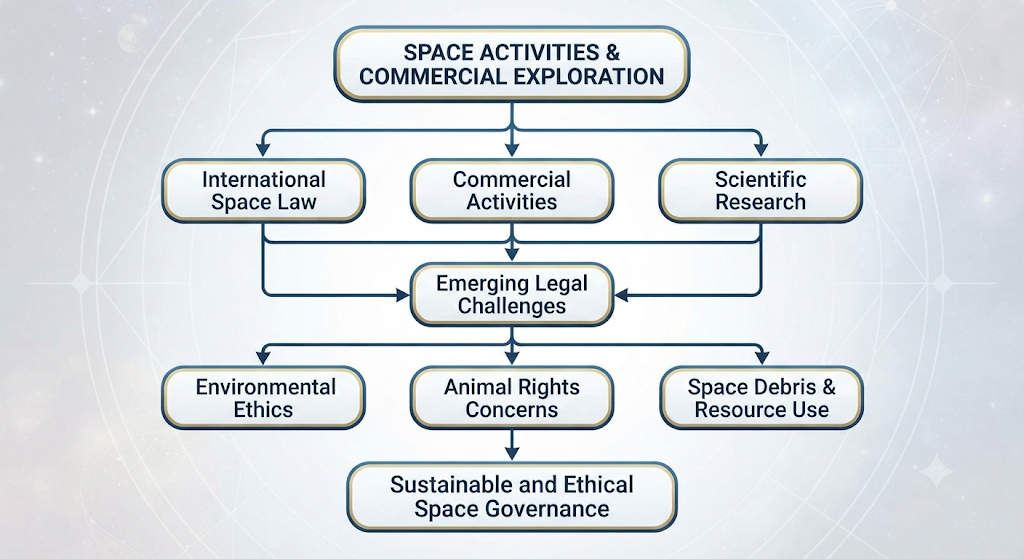
Figure: Conceptual Background
The concept of planetary protection has gained prominence as scientists and policymakers seek to prevent harmful contamination of celestial bodies and preserve the integrity of future scientific research. Additionally, the historical and ongoing use of animals in space experimentation has generated ethical debates concerning animal welfare, scientific necessity, and the applicability of animal rights principles beyond terrestrial contexts. While animals have contributed significantly to scientific understanding of space travel, contemporary ethical standards increasingly demand stronger protections and alternatives to animal testing. Advances in biotechnology, artificial intelligence, and simulation technologies have created opportunities to reduce dependence on animal experimentation in space research. The growing involvement of private corporations further complicates regulatory governance because existing international legal frameworks primarily focus on state responsibility rather than direct regulation of private actors. This paper examines the legal framework governing space activities and commercial space exploration by analyzing international space treaties, environmental ethics principles, animal welfare considerations, and contemporary legal developments. It evaluates emerging challenges associated with commercial expansion into outer space and proposes legal reforms aimed at promoting sustainable, equitable, and ethically responsible space governance in the twenty-first century.
2. International Legal Framework Governing Space Activities and Commercial Space Exploration: Environmental Ethics, Animal Rights, and Contemporary Legal Developments
The international legal framework governing space activities has developed through a series of multilateral treaties, United Nations resolutions, customary international law, and national legislation aimed at ensuring the peaceful, sustainable, and responsible use of outer space. The foundation of modern space law is the Outer Space Treaty (OST), 1967, which establishes the fundamental principles governing activities in outer space. The Treaty declares that outer space, including the Moon and other celestial bodies, shall be explored and used for the benefit and in the interests of all countries, irrespective of their level of economic or scientific development. It prohibits national appropriation of outer space by sovereignty claims, occupation, or any other means, restricts the placement of nuclear weapons and other weapons of mass destruction in space, and imposes international responsibility upon States for both governmental and non-governmental space activities. Under Article VI of the Treaty, States remain internationally responsible for the activities of private commercial entities operating under their jurisdiction, thereby requiring national authorization and continuing supervision of commercial space enterprises. Complementing the Outer Space Treaty are several specialized conventions, including the Rescue Agreement (1968), which requires States to assist astronauts in distress and return them safely; the Liability Convention (1972), establishing liability for damage caused by space objects; the Registration Convention (1975), requiring States to register objects launched into outer space; and the Moon Agreement (1979), which seeks to regulate activities on the Moon and other celestial bodies, although its limited ratification has reduced its practical effectiveness. The United Nations Committee on the Peaceful Uses of Outer Space (UNCOPUOS) plays a central role in developing international cooperation, promoting legal harmonization, and adopting guidelines relating to the long-term sustainability of outer space activities. Contemporary legal governance also incorporates planetary protection principles, developed in cooperation with the Committee on Space Research (COSPAR), to prevent harmful biological contamination of celestial bodies and protect Earth's environment from extraterrestrial materials. Environmental ethics has become increasingly integrated into space governance through international efforts addressing space debris mitigation, orbital sustainability, responsible resource utilization, and preservation of the space environment for future generations. Ethical concerns also extend to the historical use of animals in scientific space missions, encouraging greater reliance on alternative research methods consistent with internationally recognized animal welfare principles such as replacement, reduction, and refinement (the Three Rs). National legal frameworks have evolved alongside international law to regulate commercial space activities. The United States Commercial Space Launch Act, the U.S. Commercial Space Launch Competitiveness Act, 2015, Luxembourg's Space Resources Act, 2017, the United Arab Emirates Space Law, 2019, and India's Indian Space Policy, 2023 together illustrate the increasing role of domestic legislation in licensing private operators, encouraging commercial investment, regulating liability, and ensuring compliance with international obligations. Collectively, these legal instruments establish the basic regulatory architecture governing commercial space exploration while highlighting the continuing need for stronger international cooperation to address emerging ethical, environmental, and commercial challenges associated with humanity's expanding presence beyond Earth.
Contemporary Legal Challenges in Commercial Space Exploration, Environmental Ethics, and Animal Rights#
The rapid commercialization of outer space has generated numerous legal and ethical challenges that existing international space law was not originally designed to address. One of the most pressing concerns is the absence of a comprehensive legal framework governing the commercial exploitation of extraterrestrial resources. While technological advancements have made asteroid mining, lunar resource extraction, and long-term planetary exploration increasingly feasible, international law remains divided regarding property rights over space resources. The principle of non-appropriation established under the Outer Space Treaty prohibits sovereignty claims over celestial bodies, yet differing national laws have created uncertainty concerning ownership of extracted resources and equitable benefit-sharing among nations. Another significant challenge involves the growing accumulation of space debris, comprising defunct satellites, discarded rocket stages, and fragmented spacecraft, which threaten operational satellites, human space missions, and future commercial activities. Existing international guidelines remain largely non-binding, limiting effective enforcement of debris mitigation obligations. Environmental ethics has therefore become an essential aspect of space governance by emphasizing sustainability, intergenerational equity, and responsible stewardship of the extraterrestrial environment. Planetary protection presents another complex legal issue, particularly regarding biological contamination resulting from human exploration of Mars, the Moon, and other celestial bodies. Preventing both forward contamination of extraterrestrial environments and backward contamination of Earth requires stronger international cooperation and scientifically informed regulatory standards. The expansion of space tourism introduces additional legal questions relating to passenger safety, operator liability, insurance requirements, informed consent, and emergency rescue obligations under international law. Simultaneously, the increasing participation of private corporations has complicated traditional concepts of state responsibility because governments remain internationally liable for private activities while possessing varying regulatory capacities. Military uses of outer space, including anti-satellite weapon testing, satellite surveillance, and dual-use technologies, further challenge the peaceful purposes principle underlying international space law and contribute to orbital debris generation. Ethical concerns also persist regarding the historical and potential future use of animals in space experimentation. Although animal research contributed significantly to early space exploration, evolving international animal welfare standards increasingly emphasize minimizing animal suffering through alternative scientific methods such as computer simulation, tissue engineering, robotics, and advanced laboratory technologies. Climate change and environmental sustainability have likewise expanded ethical discussions by recognizing that responsible space activities should minimize environmental impacts throughout spacecraft production, launch operations, orbital missions, and post-mission disposal. Jurisdictional conflicts, liability disputes, cybersecurity risks affecting satellite infrastructure, and inadequate international dispute resolution mechanisms further complicate commercial space governance. Developing countries also face challenges in accessing emerging space economies because technological, financial, and regulatory disparities limit equitable participation in commercial opportunities. Addressing these multidimensional legal challenges requires modernized international treaties, stronger environmental safeguards, harmonized national legislation, effective regulation of private operators, improved space traffic management, enhanced protection of animal welfare, and greater international cooperation to ensure that commercial space exploration remains peaceful, sustainable, inclusive, and ethically responsible.
Future Directions and Legal Reforms for Sustainable and Ethical Space Governance#
The continued expansion of commercial space exploration requires international law to evolve beyond its traditional state-centric framework and establish comprehensive legal standards capable of addressing emerging technological, environmental, and ethical challenges. Future reforms should prioritize the modernization of the international space law regime through updated multilateral agreements that clarify the legal status of space resource utilization, commercial mining, private ownership of extracted materials, and equitable benefit-sharing while preserving the foundational principles of the Outer Space Treaty. Greater international cooperation should be promoted through the United Nations Committee on the Peaceful Uses of Outer Space (UNCOPUOS) by developing legally binding standards governing space traffic management, orbital sustainability, debris mitigation, and environmental protection. States should adopt stricter national licensing requirements requiring commercial operators to conduct environmental impact assessments before undertaking major space missions, particularly where activities may affect celestial bodies or contribute significantly to orbital pollution. Planetary protection protocols should be strengthened through internationally harmonized scientific standards designed to prevent biological contamination of extraterrestrial environments and protect Earth's ecosystems from extraterrestrial materials. Future governance should also incorporate principles of environmental ethics, recognizing outer space as a shared global environment requiring responsible stewardship for present and future generations. Advances in biotechnology, robotics, artificial intelligence, and simulation technologies provide opportunities to substantially reduce or eliminate the use of animals in space research, consistent with internationally recognized animal welfare principles emphasizing replacement, reduction, and refinement. Governments should therefore encourage research methodologies that minimize animal experimentation while supporting scientific innovation. International legal reforms should also strengthen liability rules applicable to commercial space operators by establishing clearer standards concerning insurance, compensation, environmental restoration, and responsibility for orbital debris. Enhanced cybersecurity standards are equally necessary to protect satellites, communication networks, navigation systems, and critical space infrastructure from cyberattacks and unauthorized interference. Developing countries should receive greater technical assistance, capacity-building support, and equitable access to space technologies through international cooperation programmes that promote inclusive participation in the global space economy. Ethical governance should further require transparency, public accountability, and international scientific collaboration in commercial space projects affecting shared human interests. Finally, greater integration between space law, environmental law, human rights law, and international economic law will facilitate a coherent legal framework capable of addressing increasingly interconnected global challenges. `
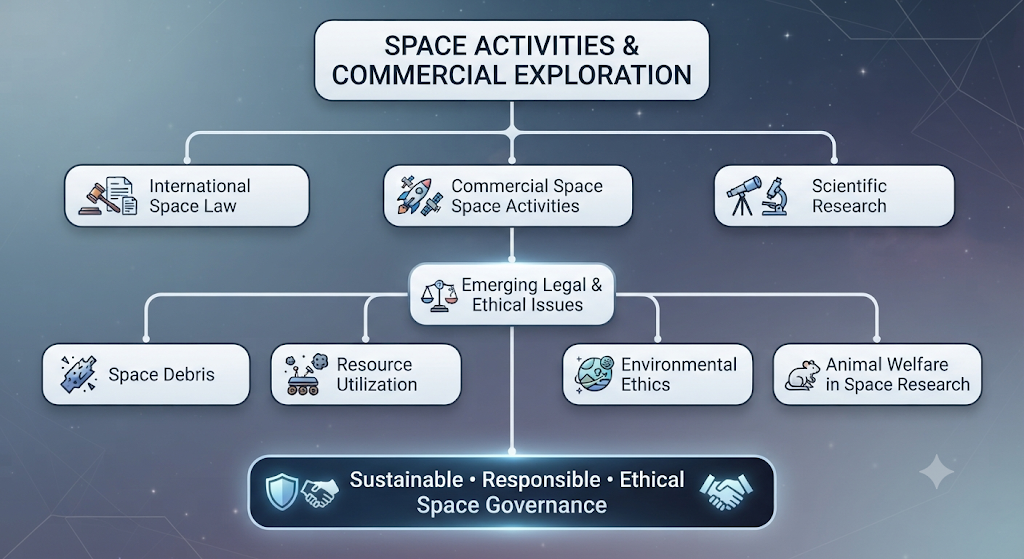
Figure: The Legal Framework Governing Space Activities and Commercial Space Exploration: Environmental Ethics, Animal Rights, and Contemporary Legal Developments
Ultimately, sustainable space governance depends upon balancing commercial innovation with environmental responsibility, scientific advancement, ethical decision-making, and international cooperation. By strengthening legal institutions, harmonizing national legislation, protecting biodiversity and animal welfare, and ensuring responsible utilization of outer space resources, the international community can establish a durable legal framework that supports peaceful, equitable, and sustainable exploration of outer space for the benefit of all humankind.
Conclusion#
The rapid expansion of commercial space exploration marks a new era in the evolution of international law, scientific innovation, and global economic development. Space is no longer an exclusive domain of governmental agencies but has become an increasingly dynamic arena involving private corporations, international partnerships, academic institutions, and emerging spacefaring nations. While this transformation presents unprecedented opportunities for technological progress, economic growth, and scientific discovery, it also introduces complex legal, environmental, and ethical challenges that existing international space law must address. The foundational principles established under the Outer Space Treaty of 1967 and related United Nations conventions continue to provide the legal basis for the peaceful use of outer space, international cooperation, state responsibility, and liability for space activities. However, the growing commercialization of space, including satellite constellations, asteroid mining, lunar resource utilization, space tourism, and private exploration missions, has exposed significant regulatory gaps concerning ownership of space resources, jurisdiction, environmental sustainability, and accountability of private actors. Environmental ethics has become an increasingly important component of space governance because expanding human activities beyond Earth create risks associated with orbital debris, planetary contamination, depletion of extraterrestrial resources, and long-term sustainability of the space environment. Protecting outer space as a shared global commons requires stronger international commitments to responsible stewardship, debris mitigation, and preservation of celestial bodies for future scientific exploration. Ethical considerations also extend to the historical and continuing use of animals in scientific space research. Advances in biotechnology, artificial intelligence, robotics, and simulation technologies provide opportunities to minimize or replace animal experimentation while ensuring that scientific progress remains consistent with internationally recognized principles of animal welfare and ethical research. Furthermore, increasing participation by private enterprises necessitates stronger national licensing systems, international supervision, and harmonized regulatory standards capable of balancing commercial innovation with public interest, environmental responsibility, and international peace. Future legal reforms should prioritize updating international space treaties, strengthening the role of the United Nations Committee on the Peaceful Uses of Outer Space (UNCOPUOS), developing legally binding rules for space traffic management, regulating commercial resource extraction, enhancing cybersecurity of space infrastructure, and promoting equitable access to the benefits of space exploration for developing countries. Greater international cooperation, transparent governance, and interdisciplinary policymaking will be essential for addressing emerging challenges associated with artificial intelligence, autonomous spacecraft, climate monitoring, biodiversity protection, and sustainable development. Ultimately, the future of space exploration depends upon establishing a balanced legal framework that promotes innovation while safeguarding environmental integrity, ethical responsibility, peaceful cooperation, and the common interests of humanity. By integrating international law, environmental ethics, and animal welfare principles into future space governance, the international community can ensure that outer space remains a peaceful, sustainable, and shared domain benefiting present and future generations.
Works Cited#
- Committee on Space Research. (2024). COSPAR Planetary Protection Policy. COSPAR.
- Government of India. (2023). Indian Space Policy, 2023. Department of Space, Government of India.
- Hobe, S., & Tronchetti, F. (2020). Space Law. Nomos/Hart Publishing.
- Lyall, F., & Larsen, P. B. (2018). Space Law: A Treatise (2nd ed.). Routledge.
- United Nations. (1967). Treaty on Principles Governing the Activities of States in the Exploration and Use of Outer Space, Including the Moon and Other Celestial Bodies (Outer Space Treaty).
- United Nations. (1968). Agreement on the Rescue of Astronauts, the Return of Astronauts and the Return of Objects Launched into Outer Space (Rescue Agreement).
- United Nations. (1972). Convention on International Liability for Damage Caused by Space Objects (Liability Convention).
- United Nations. (1975). Convention on Registration of Objects Launched into Outer Space (Registration Convention).
- United Nations. (1979). Agreement Governing the Activities of States on the Moon and Other Celestial Bodies (Moon Agreement).
- United Nations Committee on the Peaceful Uses of Outer Space. (2019). Guidelines for the Long-term Sustainability of Outer Space Activities. United Nations.
- United Nations Office for Outer Space Affairs. (2024). Space Law Treaties and Principles. United Nations.
- United States Congress. (2015). U.S. Commercial Space Launch Competitiveness Act.
- von der Dunk, F. G. (2015). Handbook of Space Law. Edward Elgar Publishing.
- World Commission on Environment and Development. (1987). Our Common Future. Oxford University Press.
- World Economic Forum. (2024). Space: The $1.8 Trillion Opportunity for Global Economic Growth. World Economic Forum.
- Cirkovic, E., & Braun, V. (2025). EU Space Law and Earth's Boundaries: Integrating Environmental Impact Assessment and Corporate Due Diligence. Global Policy.
- Flamm, P., Lambach, D., Schaefer-Rolffs, U., Stolle, C., & Braun, V. (2025). Space sustainability through atmosphere pollution? De-orbiting, atmosphere-blindness and planetary environmental injustice. Global Policy.
- Mo, W., Kinsey, B., Vickers, J., Helvajian, H., Cozmuta, I., Herron, M., et al. (2024). Conceptualizing space environmental sustainability. npj Advanced Manufacturing, 1(2).
- Seylani, A., Galsinh, A. S., Tasoula, A., et al. (2024). Ethical considerations for the age of non-governmental space exploration. Nature Communications, 15.
- Yadav, R., & Singh, A. (2025). Balancing commercialization and sustainability in outer space: Addressing new challenges. Acta Astronautica, 229, 895–900.