Abstract
Artificial Intelligence (AI) has emerged as one of the most transformative technologies of the twenty-first century, revolutionizing governance, healthcare, finance, education, criminal justice, employment, and public administration. AI-driven decision-making systems increasingly influence legal and administrative processes by automating decisions that affect individuals' rights and opportunities. While these technologies offer significant advantages in terms of efficiency, consistency, and innovation, they also raise serious legal and ethical concerns regarding algorithmic bias, discrimination, transparency, accountability, and the protection of fundamental rights. Algorithmic bias may arise from biased datasets, flawed design, or unequal representation, leading to discriminatory outcomes against individuals based on race, gender, ethnicity, disability, age, religion, or socio-economic status. Such outcomes challenge the constitutional principle of equality before the law and undermine public confidence in automated decision-making systems. International organizations and national governments have responded by developing legal and ethical frameworks that promote fairness, transparency, explainability, and human oversight in AI governance. This paper critically examines the relationship between artificial intelligence, algorithmic bias, and equality before the law through an analysis of international legal standards, comparative constitutional principles, judicial developments, and emerging regulatory approaches. It further evaluates contemporary challenges associated with AI governance and proposes legal reforms aimed at ensuring responsible, transparent, and non-discriminatory deployment of artificial intelligence while safeguarding human dignity, equality, and the rule of law in an increasingly digital society.
- Artificial Intelligence
- Algorithmic Bias
- Equality before Law
- AI Governance
- Non-Discrimination
- Human Rights
- Constitutional Law
- Ethical AI
- Transparency
- Accountability
Introduction#
Artificial Intelligence (AI) has fundamentally transformed modern society by enabling machines to perform tasks that traditionally required human intelligence, including decision-making, prediction, language processing, image recognition, and automated reasoning. Governments, businesses, courts, healthcare institutions, educational organizations, and financial sectors increasingly rely upon AI-driven technologies to improve efficiency, reduce operational costs, enhance public service delivery, and support evidence-based decision-making. AI systems now influence numerous aspects of daily life, including recruitment processes, credit scoring, healthcare diagnosis, predictive policing, judicial risk assessment, taxation, immigration control, social welfare distribution, and digital governance. While these technological advancements have generated significant economic and social benefits, they have simultaneously introduced profound legal and constitutional concerns regarding fairness, accountability, transparency, privacy, and equality before the law. One of the most significant challenges associated with AI is the phenomenon of algorithmic bias, whereby automated systems produce discriminatory outcomes because of biased training data, flawed algorithmic design, unequal representation, historical discrimination, or insufficient oversight. Algorithmic bias may disproportionately disadvantage individuals or communities based on race, gender, ethnicity, disability, religion, age, language, or socio-economic background, thereby undermining constitutional guarantees of equality and non-discrimination. The increasing use of AI in public administration and legal decision-making raises particularly important constitutional questions concerning due process, procedural fairness, judicial independence, explainability, and accountability. International organizations, including the United Nations, the Organisation for Economic Co-operation and Development (OECD), UNESCO, the Council of Europe, and the European Union, have responded by developing ethical principles and regulatory frameworks promoting trustworthy artificial intelligence based upon human rights, transparency, fairness, accountability, and human oversight.
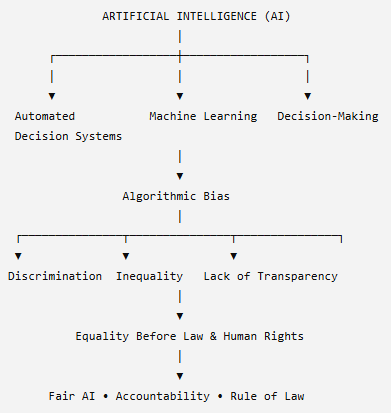
Figure: Conceptual Background
Several jurisdictions have also introduced legislation regulating high-risk AI systems, algorithmic accountability, and automated decision-making while balancing technological innovation with protection of fundamental rights. In India, constitutional principles of equality under Articles 14, 15, and 16, together with evolving digital governance policies and the Digital Personal Data Protection Act, 2023, provide an important legal context for addressing algorithmic discrimination. Similarly, comparative legal developments such as the European Union Artificial Intelligence Act demonstrate an increasing commitment to risk-based AI regulation. Emerging technologies including generative AI, facial recognition systems, autonomous decision-making, predictive analytics, and machine learning continue to reshape legal governance while generating new questions regarding liability, explainability, human control, and judicial review. This paper critically examines the legal relationship between artificial intelligence, algorithmic bias, and equality before the law through the perspectives of constitutional law, international human rights, comparative AI regulation, and emerging digital governance frameworks. It evaluates the principal legal challenges posed by biased algorithmic systems and proposes reforms aimed at ensuring responsible, transparent, fair, and accountable use of artificial intelligence consistent with constitutional values, human dignity, and the rule of law in the digital age.
International and Constitutional Legal Framework Governing Artificial Intelligence, Algorithmic Bias, and Equality before Law#
The increasing deployment of Artificial Intelligence (AI) across public and private sectors has prompted governments and international organizations to develop legal frameworks that ensure technological innovation remains consistent with constitutional principles, human rights, and the rule of law. At the international level, several soft-law instruments and emerging regulatory frameworks emphasize that AI systems must operate in accordance with the principles of legality, fairness, transparency, accountability, non-discrimination, and respect for human dignity. The United Nations Educational, Scientific and Cultural Organization (UNESCO) Recommendation on the Ethics of Artificial Intelligence (2021) provides the first global normative framework addressing ethical AI governance. It requires States to ensure that AI systems respect human rights, promote equality, eliminate discrimination, protect privacy, and remain subject to meaningful human oversight. Similarly, the Organisation for Economic Co-operation and Development (OECD) Principles on Artificial Intelligence (2019) encourage member states to adopt trustworthy AI systems that are transparent, explainable, robust, secure, and accountable throughout their lifecycle. The Council of Europe Framework Convention on Artificial Intelligence, Human Rights, Democracy and the Rule of Law (2024) further seeks to ensure that AI development remains compatible with democratic governance and fundamental rights. Within the European Union, the Artificial Intelligence Act (EU AI Act), 2024 establishes the world's first comprehensive and legally binding framework governing AI through a risk-based regulatory model. High-risk AI systems used in sectors such as employment, education, healthcare, law enforcement, border control, and judicial administration are subject to stringent obligations relating to transparency, risk assessment, human oversight, data quality, documentation, and post-market monitoring. AI systems posing unacceptable risks, including certain forms of social scoring and manipulative AI practices, are prohibited. The General Data Protection Regulation (GDPR) complements AI regulation by providing individuals with rights concerning automated decision-making, data protection, transparency, and access to effective legal remedies. In the constitutional context, the principle of equality before the law requires that governmental decisions affecting individual rights must be free from arbitrary discrimination. In India, Articles 14, 15, and 16 of the Constitution guarantee equality before the law, prohibit discrimination, and ensure equal opportunity in public employment. These constitutional guarantees become particularly relevant where AI systems influence recruitment, welfare distribution, policing, taxation, or administrative decision-making. Judicial decisions interpreting Article 14 have consistently emphasized that state action must satisfy standards of fairness, reasonableness, and non-arbitrariness, principles equally applicable to algorithmic governance. The Digital Personal Data Protection Act, 2023, though primarily addressing personal data processing, contributes indirectly to AI governance by strengthening data protection, consent requirements, and accountability in digital systems. Comparative constitutional developments in countries such as Canada, Germany, and South Africa similarly recognize equality and due process as fundamental safeguards against discriminatory automated decision-making. Collectively, these international and constitutional frameworks establish that AI must serve society without undermining equality, justice, or human dignity. They further recognize that technological innovation should always remain subject to legal oversight, democratic accountability, and effective judicial review to prevent algorithmic bias from eroding the constitutional guarantee of equality before the law.
Contemporary Challenges of Algorithmic Bias and Equality before Law#
Despite remarkable advancements in Artificial Intelligence, the increasing reliance on algorithmic decision-making presents significant legal and constitutional challenges relating to equality before the law. One of the most serious concerns is algorithmic bias, which occurs when AI systems generate discriminatory outcomes because of biased training datasets, flawed model design, unequal representation, or historical patterns of discrimination embedded within data. Such bias may disproportionately affect individuals based on race, gender, caste, ethnicity, religion, disability, age, language, or socio-economic background, thereby violating constitutional guarantees of equality and non-discrimination. AI systems used in recruitment, credit scoring, healthcare, predictive policing, facial recognition, criminal sentencing, immigration control, insurance, and social welfare distribution have demonstrated the potential to reinforce existing societal inequalities rather than eliminate them. The problem is particularly significant when automated systems rely on historical data reflecting past discriminatory practices, causing algorithms to reproduce and amplify those inequities. Another major challenge concerns the lack of transparency and explainability associated with complex machine learning models, often described as "black box" systems. Individuals adversely affected by automated decisions may be unable to understand how decisions were reached or effectively challenge them before administrative or judicial authorities. This lack of explainability undermines procedural fairness, due process, and access to effective legal remedies. Facial recognition technologies illustrate another important concern, as studies have demonstrated varying levels of accuracy across demographic groups, increasing the risk of wrongful identification, discriminatory surveillance, and unjust law enforcement actions. AI-driven surveillance systems also raise constitutional questions regarding privacy, freedom of expression, and freedom of assembly when deployed without adequate legal safeguards. The growing use of generative AI introduces additional risks relating to misinformation, deepfakes, discriminatory content generation, and manipulation of public discourse, potentially affecting democratic processes and public trust. Determining legal accountability for AI-generated decisions remains another complex issue because responsibility may be shared among developers, software providers, deployers, data controllers, public authorities, and end users. Cross-border deployment of AI systems further complicates regulatory enforcement due to differing national legal standards governing discrimination, privacy, liability, and consumer protection. Small organizations and developing countries frequently lack sufficient technical expertise and regulatory capacity to evaluate algorithmic fairness effectively. Moreover, excessive dependence on automated decision-making may gradually diminish meaningful human judgment in areas requiring ethical reasoning, empathy, and contextual evaluation. Addressing these multidimensional challenges requires comprehensive legal regulation emphasizing transparency, independent algorithmic audits, diverse and representative datasets, human oversight, anti-discrimination safeguards, judicial review, and continuous monitoring of AI systems throughout their operational lifecycle. Only through such rights-based governance can artificial intelligence contribute to social progress without compromising the constitutional principle of equality before the law.
Future Directions and Legal Reforms for Responsible AI Governance#
Ensuring that Artificial Intelligence develops consistently with constitutional values and international human rights requires comprehensive legal reforms supported by effective institutional governance and international cooperation. Future regulatory frameworks should adopt a risk-based approach that subjects high-risk AI systems affecting employment, education, healthcare, criminal justice, financial services, public administration, and law enforcement to stricter legal obligations while allowing lower-risk innovations to develop under proportionate regulatory oversight. Governments should enact comprehensive AI legislation requiring transparency, explainability, fairness, accountability, and meaningful human oversight throughout the lifecycle of AI systems. Mandatory algorithmic impact assessments, independent audits, bias testing, and periodic compliance reviews should become standard legal requirements before deploying AI systems capable of affecting individual rights or public interests.
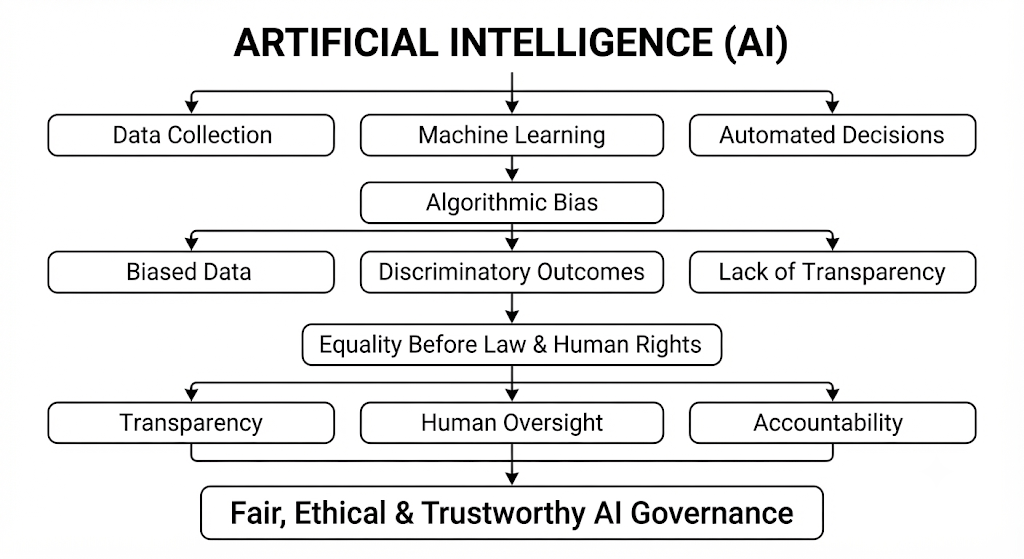
Figure: Artificial Intelligence, Algorithmic Bias, and Equality before Law
Developers should be legally obligated to utilize representative, diverse, and regularly updated datasets while implementing robust bias detection and mitigation techniques to minimize discriminatory outcomes. Regulatory authorities should establish specialized supervisory bodies with technical expertise capable of monitoring AI deployment, investigating complaints, imposing penalties, and issuing binding compliance guidance. International cooperation should be strengthened through organizations such as the United Nations, UNESCO, OECD, Council of Europe, and the Global Partnership on AI (GPAI) to encourage harmonized regulatory standards, information sharing, and coordinated responses to emerging technological risks. Governments should further integrate constitutional principles of equality, proportionality, due process, and human dignity into AI governance policies, ensuring that automated decision-making remains subject to judicial review and effective legal remedies. Public institutions should maintain meaningful human involvement in decisions significantly affecting fundamental rights, thereby preventing excessive dependence on opaque algorithmic systems. Educational institutions and professional organizations should promote AI literacy, legal awareness, and ethical training among policymakers, judges, lawyers, software developers, and public administrators. Businesses deploying AI should adopt ethical governance frameworks based on privacy-by-design, fairness-by-design, and accountability-by-design principles while maintaining detailed documentation supporting regulatory compliance. Greater public participation in AI policymaking can also strengthen democratic legitimacy and societal trust in emerging technologies. As generative AI, autonomous systems, and advanced machine learning continue to evolve, legal frameworks must remain technologically neutral yet adaptable to future innovations. Ultimately, artificial intelligence should function as an instrument that enhances justice, equality, and human welfare rather than reinforcing discrimination or arbitrary decision-making. By combining constitutional safeguards, international human rights standards, transparent regulation, and responsible technological innovation, governments can ensure that AI contributes to an inclusive digital society where equality before the law remains fully protected in the age of intelligent machines.
Conclusion#
Artificial Intelligence has become an indispensable component of modern governance, commerce, healthcare, education, finance, law enforcement, and judicial administration, offering unprecedented opportunities to improve efficiency, innovation, and public service delivery. However, the increasing reliance on automated decision-making systems has simultaneously exposed significant constitutional, legal, and ethical concerns relating to algorithmic bias, discrimination, transparency, accountability, and equality before the law. Algorithmic bias arising from biased datasets, flawed model design, unequal representation, or insufficient human oversight may produce discriminatory outcomes that disproportionately affect individuals based on race, gender, caste, ethnicity, disability, religion, age, or socio-economic status. Such outcomes undermine the constitutional guarantee of equality, erode public confidence in digital governance, and threaten the legitimacy of automated decision-making in both public and private sectors. International organizations including the United Nations, UNESCO, the OECD, and the Council of Europe, together with regional initiatives such as the European Union Artificial Intelligence Act, have established important principles emphasizing fairness, transparency, explainability, accountability, human oversight, and respect for fundamental rights. Constitutional frameworks, including India's guarantees under Articles 14, 15, and 16, reinforce the obligation of governments to ensure that technological innovation does not result in arbitrary or discriminatory treatment. Nevertheless, contemporary legal systems continue to face substantial challenges in regulating rapidly evolving AI technologies, particularly in areas such as facial recognition, predictive policing, generative AI, automated recruitment, healthcare algorithms, and financial decision-making. Effective AI governance therefore requires comprehensive legislation supported by independent regulatory institutions, mandatory algorithmic impact assessments, bias testing, periodic audits, transparent documentation, and accessible mechanisms for judicial review. Human oversight should remain central to all high-risk AI applications affecting fundamental rights, ensuring that automated systems complement rather than replace human judgment. Businesses and technology developers must also embrace ethical design principles, representative datasets, privacy-by-design, fairness-by-design, and continuous monitoring throughout the lifecycle of AI systems. International cooperation is equally essential for harmonizing regulatory standards, sharing technical expertise, and addressing the cross-border nature of AI development and deployment. Public awareness and digital literacy programmes should empower individuals to understand AI-driven decisions and exercise their legal rights effectively. Ultimately, artificial intelligence should function as a tool that strengthens equality, justice, and human dignity rather than reinforcing historical discrimination or creating new forms of inequality. By integrating constitutional safeguards, international human rights principles, responsible innovation, and transparent regulatory oversight, governments can ensure that AI contributes to inclusive development while preserving equality before the law, democratic governance, and the rule of law in the digital age.
Works Cited#
- Council of Europe. (2024). Framework Convention on Artificial Intelligence, Human Rights, Democracy and the Rule of Law. Council of Europe.
- European Parliament and Council of the European Union. (2024). Artificial Intelligence Act (Regulation (EU) 2024/1689). Official Journal of the European Union.
- European Parliament and Council of the European Union. (2016). General Data Protection Regulation (Regulation (EU) 2016/679). Official Journal of the European Union.
- Government of India. (1950). The Constitution of India. Ministry of Law and Justice.
- Government of India. (2023). Digital Personal Data Protection Act, 2023. Ministry of Electronics and Information Technology.
- Organisation for Economic Co-operation and Development. (2019). OECD Principles on Artificial Intelligence. OECD Publishing.
- Russell, S., & Norvig, P. (2021). Artificial Intelligence: A Modern Approach (4th ed.). Pearson.
- UNESCO. (2021). Recommendation on the Ethics of Artificial Intelligence. UNESCO.
- United Nations. (1948). Universal Declaration of Human Rights. United Nations.
- United Nations. (1966). International Covenant on Civil and Political Rights. United Nations.
- United Nations. (1966). International Covenant on Economic, Social and Cultural Rights. United Nations.
- World Economic Forum. (2024). The Global Risks Report 2024. World Economic Forum.
- Barocas, S., Hardt, M., & Narayanan, A. (2023). Fairness and Machine Learning: Limitations and Opportunities. MIT Press.
- Mittelstadt, B. D., Allo, P., Taddeo, M., Wachter, S., & Floridi, L. (2016). The Ethics of Algorithms: Mapping the Debate. Big Data & Society, 3(2), 1–21.
- Wachter, S., Mittelstadt, B., & Floridi, L. (2017). Why a Right to Explanation of Automated Decision-Making Does Not Exist in the General Data Protection Regulation. International Data Privacy Law, 7(2), 76–99.
- NIST. (2023). AI Risk Management Framework (AI RMF 1.0). National Institute of Standards and Technology.
- Goodman, B., & Flaxman, S. (2017). European Union regulations on algorithmic decision-making and a "right to explanation." AI Magazine, 38(3), 50–57.
- National Institute of Standards and Technology. (2023). Artificial Intelligence Risk Management Framework (AI RMF 1.0). U.S. Department of Commerce.
- World Health Organization. (2021). Ethics and Governance of Artificial Intelligence for Health. World Health Organization.
- Yeung, K. (2018). Algorithmic regulation: A critical interrogation. Regulation & Governance, 12(4), 505–523.