Abstract
Artificial Intelligence (AI) has become a transformative technology influencing governance, healthcare, finance, transportation, education, defence, and international commerce. As AI systems increasingly operate across national boundaries through cloud computing, digital platforms, and multinational technology companies, regulating their development and deployment has emerged as one of the most significant legal challenges of the twenty-first century. Cross-border AI systems generate complex issues concerning jurisdiction, data governance, privacy protection, cybersecurity, intellectual property, liability, human rights, algorithmic transparency, and international regulatory coordination. National legal frameworks often differ considerably in their approaches to AI governance, resulting in fragmented regulations that complicate enforcement and compliance for governments and businesses alike. While jurisdictions such as the European Union have adopted comprehensive risk-based AI regulations, other countries continue to rely on sector-specific or voluntary governance models. This regulatory divergence creates uncertainty regarding accountability for AI-generated decisions, cross-border data transfers, automated decision-making, and the protection of fundamental rights. International organizations, including the United Nations, UNESCO, OECD, and the Council of Europe, have increasingly advocated harmonized AI governance principles emphasizing transparency, fairness, accountability, safety, and respect for human rights. This paper critically examines the legal challenges associated with regulating cross-border AI systems through a comparative analysis of international legal instruments and selected national frameworks. It evaluates jurisdictional conflicts, ethical concerns, regulatory fragmentation, and emerging international governance initiatives while proposing future legal reforms necessary to establish responsible, transparent, and globally coordinated AI regulation that promotes innovation without compromising fundamental rights, public trust, and international legal cooperation.
- Artificial Intelligence
- Cross-Border Regulation
- AI Governance
- International Law
- Digital Governance
- Algorithmic Accountability
- Data Protection
- Human Rights
- Jurisdiction
- Comparative Legal Analysis
Introduction#
Artificial Intelligence (AI) has rapidly evolved from a specialized technological innovation into a foundational component of the global digital economy. Modern AI systems increasingly support decision-making in diverse sectors including healthcare, finance, transportation, public administration, criminal justice, education, defence, international trade, and scientific research. The integration of cloud computing, big data analytics, machine learning, and advanced communication networks has enabled AI systems to operate seamlessly across national borders, allowing organizations to develop, deploy, and manage AI applications simultaneously in multiple jurisdictions. Multinational technology companies routinely collect data from users located in different countries, process that information through cloud-based infrastructures situated elsewhere, and deliver AI-generated services globally. While these developments have accelerated innovation, improved productivity, and facilitated economic growth, they have also generated unprecedented legal challenges concerning jurisdiction, regulatory authority, accountability, privacy, cybersecurity, intellectual property, consumer protection, and the safeguarding of fundamental human rights. The inherently borderless nature of digital technologies frequently conflicts with territorially based legal systems, creating uncertainty regarding which national laws apply when AI systems operate across multiple jurisdictions. Consequently, governments face increasing difficulty in regulating AI technologies whose development, deployment, and impact transcend conventional geographical boundaries.
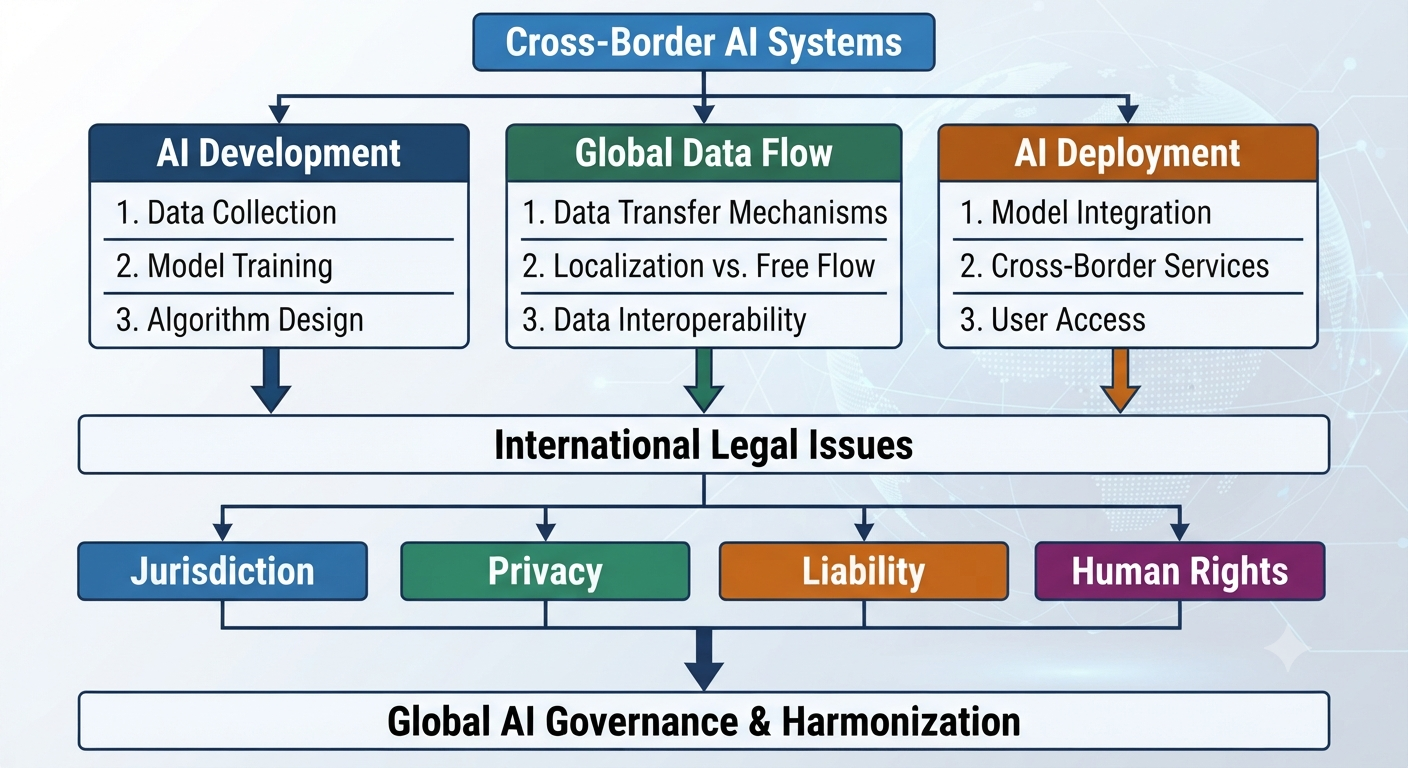
Figure: Conceptual Backgound
The legal regulation of cross-border AI systems has therefore emerged as one of the most significant issues in contemporary digital governance. Different countries have adopted divergent regulatory strategies reflecting their constitutional traditions, economic priorities, technological capabilities, and policy objectives. The European Union has introduced a comprehensive risk-based regulatory framework through the AI Act, emphasizing transparency, human oversight, accountability, and protection of fundamental rights. In contrast, jurisdictions such as the United States have generally relied on sector-specific regulations and innovation-oriented policies, while countries including China have implemented more centralized approaches emphasizing national security and state oversight. These regulatory differences create compliance challenges for multinational corporations, complicate international trade, and increase legal uncertainty regarding liability, cross-border data transfers, automated decision-making, and algorithmic governance. International organizations such as the United Nations, UNESCO, OECD, G7, and the Council of Europe have responded by developing global principles promoting trustworthy AI, ethical governance, transparency, fairness, and international cooperation. Nevertheless, the absence of a universally binding international legal framework continues to hinder effective cross-border AI regulation. This paper critically examines the principal legal challenges associated with regulating cross-border AI systems through a comparative analysis of international legal standards and selected national regulatory approaches. It evaluates jurisdictional conflicts, data governance, algorithmic accountability, ethical considerations, and emerging global governance initiatives while identifying future reforms necessary to establish coherent, transparent, and internationally coordinated AI regulation capable of balancing technological innovation with the protection of human rights, democratic values, and the rule of law.
International and Comparative Legal Framework Governing Cross-Border Artificial Intelligence Systems#
The rapid expansion of Artificial Intelligence (AI) across international borders has compelled governments, regional organizations, and international institutions to develop legal frameworks capable of regulating AI while balancing innovation, economic development, and the protection of fundamental rights. At the global level, although no comprehensive binding treaty specifically governs AI, several international organizations have established important principles that influence national legislation and policy development. The United Nations has consistently emphasized that AI governance should uphold human rights, equality, transparency, accountability, and sustainable development. Similarly, UNESCO's Recommendation on the Ethics of Artificial Intelligence (2021) provides the first global normative framework addressing ethical AI, encouraging member states to ensure fairness, privacy protection, human oversight, environmental sustainability, and non-discrimination in AI deployment. The Organisation for Economic Co-operation and Development (OECD) adopted the OECD AI Principles, which promote trustworthy AI through transparency, robustness, accountability, security, and respect for democratic values. These principles have significantly influenced AI policies in numerous countries. The Council of Europe has also initiated negotiations on an international legal instrument concerning AI and human rights, seeking to establish common standards applicable across multiple jurisdictions. Among regional frameworks, the European Union AI Act represents the world's first comprehensive AI legislation, adopting a risk-based regulatory model that classifies AI systems into unacceptable, high-risk, limited-risk, and minimal-risk categories. High-risk AI applications, including those used in healthcare, employment, education, law enforcement, and critical infrastructure, must satisfy stringent obligations relating to transparency, human oversight, data quality, cybersecurity, risk management, and conformity assessment before entering the market. In contrast, the United States follows a decentralized and sector-specific regulatory approach that emphasizes innovation while relying on existing consumer protection, privacy, and anti-discrimination laws to regulate AI. Executive orders and voluntary frameworks issued by federal agencies encourage responsible AI development without establishing a unified national AI statute. China has adopted a comparatively centralized regulatory model focusing on algorithmic governance, content moderation, cybersecurity, national security, and state supervision. Chinese regulations require recommendation algorithms and generative AI systems to comply with government oversight while promoting transparency and social stability. In India, AI regulation remains at an evolving stage, with policy initiatives emphasizing responsible innovation, digital governance, data protection, and ethical AI without enacting dedicated AI legislation. Cross-border AI operations create significant legal uncertainty because multinational corporations frequently develop AI models in one jurisdiction, process data in another, and provide services worldwide. Consequently, businesses must comply simultaneously with multiple regulatory regimes governing privacy, cybersecurity, intellectual property, consumer protection, and algorithmic accountability. Comparative legal analysis demonstrates that while jurisdictions differ in regulatory intensity and enforcement mechanisms, there is increasing international consensus regarding the necessity of transparency, human oversight, fairness, explainability, accountability, and protection of fundamental rights. Future legal harmonization will require greater international cooperation, mutual recognition of regulatory standards, cross-border enforcement mechanisms, and interoperable governance frameworks capable of supporting innovation while ensuring responsible and trustworthy deployment of AI technologies across global digital ecosystems.
Major Legal Challenges in Regulating Cross-Border Artificial Intelligence Systems#
The regulation of cross-border Artificial Intelligence (AI) systems presents numerous legal challenges because AI technologies operate across jurisdictions that possess diverse constitutional values, regulatory priorities, and legal traditions. One of the foremost challenges is jurisdictional uncertainty, as AI systems often involve data collection in one country, algorithm development in another, cloud-based processing in multiple jurisdictions, and service delivery across the globe. Determining which country's laws apply in cases involving privacy violations, discriminatory AI decisions, contractual disputes, or AI-related harm has become increasingly complex. Closely connected to jurisdiction is the challenge of cross-border data governance, where conflicting data protection laws regulate international transfers of personal information. Regulations such as the European Union's General Data Protection Regulation (GDPR) impose strict conditions on transferring personal data outside the European Economic Area, while other jurisdictions adopt comparatively flexible approaches. These differences create compliance burdens for multinational organizations developing and deploying AI applications internationally. Another significant challenge concerns algorithmic accountability and liability. AI systems increasingly make autonomous or semi-autonomous decisions affecting employment, healthcare, financial services, criminal justice, transportation, and public administration. When such systems produce erroneous, discriminatory, or harmful outcomes, determining legal responsibility among software developers, technology companies, cloud service providers, users, and governments remains highly uncertain. Existing liability frameworks were generally designed for human decision-makers rather than autonomous AI systems. Transparency and explainability present additional legal concerns because many advanced machine learning models function as "black boxes," making it difficult for affected individuals, regulators, and courts to understand how particular decisions are reached. The absence of explainable AI complicates judicial review, procedural fairness, and effective legal remedies. Human rights protection represents another critical regulatory challenge, particularly where AI systems affect privacy, equality, freedom of expression, non-discrimination, due process, and access to public services. Biased training data, discriminatory algorithms, and automated profiling may reinforce existing social inequalities while disproportionately affecting vulnerable populations. Intellectual property issues further complicate cross-border AI governance, especially regarding ownership of AI-generated content, copyright protection for training datasets, patent eligibility of AI-generated inventions, and unauthorized use of copyrighted materials during AI model training. Cybersecurity also remains a major concern because AI systems are increasingly targeted through adversarial attacks, data poisoning, model manipulation, and unauthorized access to sensitive information. Divergent national cybersecurity regulations often create inconsistent security obligations across jurisdictions. Moreover, regulatory fragmentation continues to hinder international AI governance because countries pursue different policy objectives relating to innovation, national security, competition, privacy, and human rights. Businesses operating globally must therefore comply with multiple, sometimes conflicting, regulatory frameworks, increasing legal uncertainty and compliance costs. These challenges demonstrate that purely domestic regulation cannot adequately govern AI technologies operating within global digital ecosystems. Effective regulation requires internationally coordinated legal standards that promote transparency, accountability, interoperability, human rights protection, cross-border regulatory cooperation, and responsible technological innovation while preserving national sovereignty a nd encouraging sustainable economic development.
Emerging Regulatory Reforms and Future Directions in Cross-Border AI Governance#
The growing deployment of Artificial Intelligence (AI) across national borders has accelerated the development of legal reforms aimed at establishing coherent, transparent, and internationally coordinated governance frameworks. Policymakers increasingly recognize that fragmented national regulations are insufficient to address the borderless nature of AI technologies, prompting greater emphasis on international cooperation and harmonized legal standards. Among the most significant developments is the European Union Artificial Intelligence Act (EU AI Act), which introduces the world's first comprehensive, risk-based legal framework governing AI systems. The Act categorizes AI applications into unacceptable, high-risk, limited-risk, and minimal-risk classifications, imposing proportionate obligations relating to transparency, risk assessment, human oversight, cybersecurity, data governance, and post-market monitoring. High-risk AI systems used in healthcare, law enforcement, education, employment, and critical infrastructure must satisfy rigorous compliance requirements before entering the European market. Beyond Europe, international organizations have intensified efforts to develop common governance principles. UNESCO's Recommendation on the Ethics of Artificial Intelligence, the OECD AI Principles, the G7 Hiroshima AI Process, and ongoing initiatives within the United Nations emphasize human rights, fairness, accountability, transparency, safety, environmental sustainability, and democratic governance as the foundation of responsible AI development. These initiatives encourage governments to adopt interoperable regulatory frameworks capable of facilitating innovation while protecting individuals from algorithmic discrimination, privacy violations, and unsafe AI deployment. Another important reform area concerns cross-border data governance, where countries are increasingly negotiating mechanisms that facilitate secure international data transfers while maintaining strong privacy protections. Harmonized standards for data localization, cybersecurity, consent, and international data-sharing agreements can significantly reduce compliance burdens for multinational organizations developing AI systems across multiple jurisdictions. Regulatory reforms also increasingly focus on algorithmic accountability and explainable AI, requiring developers to provide meaningful information regarding automated decision-making processes, maintain documentation of AI models, conduct impact assessments, and implement human oversight mechanisms for high-risk applications. Explainability enhances judicial review, regulatory supervision, and public trust by allowing affected individuals to challenge AI-generated decisions effectively.
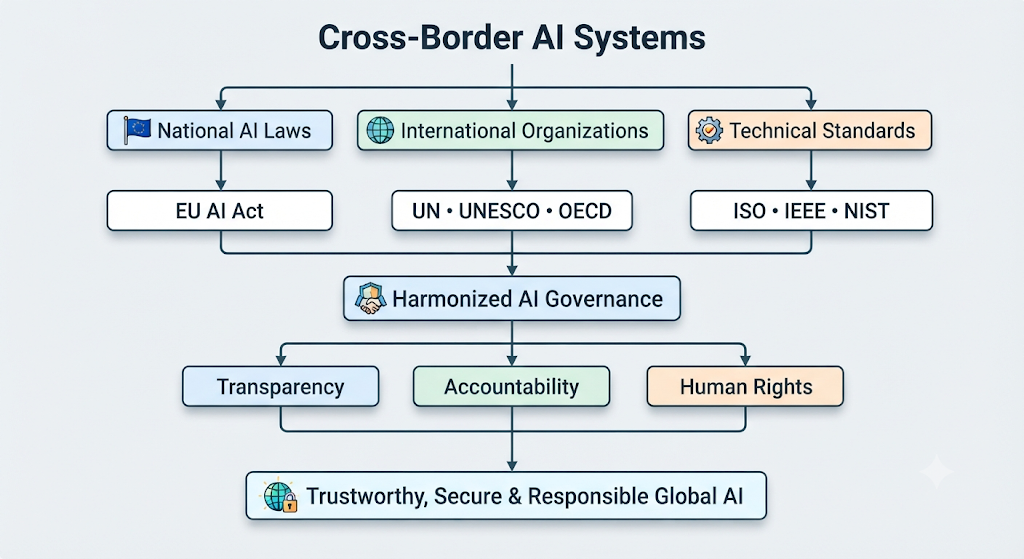
Figure: Emerging Regulatory Reforms and Future Directions in Cross-Border AI Governance
In addition, governments are exploring AI liability frameworks that clearly allocate legal responsibility among developers, deployers, operators, and service providers when AI systems cause economic loss, discrimination, or physical harm. Such frameworks are expected to improve legal certainty and encourage responsible innovation. International regulatory cooperation is also expanding through bilateral agreements, multilateral forums, and technical standard-setting organizations that seek to harmonize AI safety requirements, cybersecurity protocols, intellectual property protections, and certification mechanisms. Future legal reforms are likely to integrate Explainable Artificial Intelligence (XAI), AI auditing systems, algorithmic impact assessments, and ethical certification standards into regulatory compliance requirements. Independent supervisory authorities may further strengthen accountability by conducting periodic audits and enforcing transparency obligations. Ultimately, sustainable governance of cross-border AI systems requires an internationally coordinated legal framework that balances innovation with accountability, promotes interoperability among national regulations, protects fundamental human rights, ensures algorithmic fairness, and fosters public confidence in AI technologies. Such an integrated approach will enable societies to harness the transformative benefits of AI while minimizing legal uncertainty and safeguarding democratic values within an increasingly interconnected digital ecosystem.
Conclusion#
Artificial Intelligence has emerged as one of the most transformative technologies of the digital era, reshaping economies, governance, international trade, healthcare, education, finance, security, and public administration. The increasing deployment of AI across national borders has created unprecedented opportunities for innovation and economic growth while simultaneously exposing significant legal challenges that transcend traditional jurisdictional boundaries. Existing legal systems, largely designed around territorially based governance, struggle to regulate AI systems that collect data globally, process information through distributed cloud infrastructures, and generate automated decisions affecting individuals in multiple jurisdictions. Comparative analysis demonstrates considerable variation among national regulatory approaches, with the European Union adopting a comprehensive risk-based framework, the United States emphasizing innovation through sector-specific regulation, China implementing centralized algorithmic governance, and several developing countries pursuing evolving policy-based approaches. Despite these differences, there is growing international consensus that effective AI regulation must be grounded in transparency, accountability, fairness, human oversight, privacy protection, cybersecurity, and respect for fundamental human rights. International organizations such as the United Nations, UNESCO, OECD, G7, and the Council of Europe have made substantial contributions toward establishing common governance principles capable of guiding national legislation and promoting responsible AI development. Nevertheless, significant challenges remain regarding jurisdictional conflicts, cross-border data transfers, liability allocation, algorithmic discrimination, intellectual property protection, and enforcement of legal obligations across multiple legal systems. Addressing these issues requires stronger international cooperation, harmonized regulatory standards, interoperable compliance mechanisms, and enhanced judicial collaboration capable of balancing national sovereignty with the global nature of AI technologies. Future governance should promote explainable artificial intelligence, independent algorithmic auditing, transparent decision-making, effective remedies for affected individuals, and adaptive legal frameworks capable of responding to rapidly evolving technological developments. Policymakers must ensure that innovation does not undermine democratic values, the rule of law, or internationally recognized human rights. Ultimately, sustainable regulation of cross-border AI systems depends upon developing coordinated legal frameworks that foster responsible technological advancement while safeguarding privacy, equality, accountability, public trust, and global digital security. A balanced international legal architecture will enable societies to maximize the benefits of Artificial Intelligence while minimizing regulatory uncertainty, protecting individual rights, and promoting ethical, secure, and inclusive AI governance in an increasingly interconnected world.
Works Cited#
- Bostrom, N. (2014). Superintelligence: Paths, Dangers, Strategies. Oxford University Press.
- Council of Europe. (2024). Framework Convention on Artificial Intelligence and Human Rights, Democracy and the Rule of Law. Strasbourg: Council of Europe.
- European Parliament & Council of the European Union. (2024). Regulation (EU) 2024/1689 Laying Down Harmonised Rules on Artificial Intelligence (Artificial Intelligence Act).
- Floridi, L., & Cowls, J. (2019). A Unified Framework of Five Principles for AI in Society. Harvard Data Science Review, 1(1), 1–15.
- Government of India. (2023). Digital Personal Data Protection Act, 2023.
- Organisation for Economic Co-operation and Development. (2019). OECD Principles on Artificial Intelligence. Paris: OECD.
- Russell, S., & Norvig, P. (2021). Artificial Intelligence: A Modern Approach (4th ed.). Pearson.
- Scherer, M. U. (2016). Regulating Artificial Intelligence Systems: Risks, Challenges, Competencies, and Strategies. Harvard Journal of Law & Technology, 29(2), 353–400.
- United Nations. (1948). Universal Declaration of Human Rights.
- United Nations. (1966). International Covenant on Civil and Political Rights.
- United Nations Educational, Scientific and Cultural Organization. (2021). Recommendation on the Ethics of Artificial Intelligence. Paris: UNESCO.
- United Nations High-Level Advisory Body on Artificial Intelligence. (2024). Governing AI for Humanity. United Nations.
- Veale, M., & Borgesius, F. Z. (2021). Demystifying the Draft EU Artificial Intelligence Act. Computer Law Review International, 22(4), 97–112.
- World Economic Forum. (2024). Global Risks Report 2024. Geneva: World Economic Forum.
- World Intellectual Property Organization. (2024). WIPO Technology Trends: Generative Artificial Intelligence. Geneva: WIPO.
- Yeung, K., & Lodge, M. (Eds.). (2019). Algorithmic Regulation. Oxford University Press.
- Zuboff, S. (2019). The Age of Surveillance Capitalism: The Fight for a Human Future at the New Frontier of Power. PublicAffairs.
- Cath, C., Wachter, S., Mittelstadt, B., Taddeo, M., & Floridi, L. (2018). Artificial Intelligence and the 'Good Society': The US, EU, and UK Approach. Science and Engineering Ethics, 24(2), 505–528.
- Mittelstadt, B. D., Allo, P., Taddeo, M., Wachter, S., & Floridi, L. (2016). The Ethics of Algorithms: Mapping the Debate. Big Data & Society, 3(2), 1–21.
- Gasser, U., & Almeida, V. A. F. (2017). A Layered Model for AI Governance. IEEE Internet Computing, 21(6), 58–62.