Abstract
Biotechnology and gene-editing technologies have revolutionized modern medicine, agriculture, environmental conservation, and scientific research. Innovations such as CRISPR-Cas9, gene therapy, stem cell technology, synthetic biology, and genome sequencing have created unprecedented opportunities for treating genetic disorders, improving food security, combating infectious diseases, and advancing personalized medicine. However, these scientific breakthroughs have also generated significant legal, ethical, and human rights challenges that extend beyond traditional regulatory frameworks. Questions relating to human dignity, genetic privacy, informed consent, reproductive rights, discrimination, intellectual property, biosafety, and equitable access to biotechnology have become central issues in contemporary legal discourse. International organizations and national governments have increasingly recognized the need for comprehensive legal frameworks capable of balancing scientific innovation with the protection of fundamental human rights. Instruments such as the UNESCO Universal Declaration on the Human Genome and Human Rights, the Oviedo Convention, and the Convention on Biological Diversity provide important legal principles governing responsible biotechnology research and application. This paper critically examines the legal regulation of biotechnology and gene editing through the lens of international human rights law, comparative legal frameworks, and emerging ethical standards. It explores the opportunities offered by biotechnology while evaluating the legal challenges associated with human genome editing, germline modification, genetic discrimination, bioethics, and regulatory accountability. The study concludes by proposing future legal reforms aimed at establishing transparent, equitable, and human-centric governance systems that promote scientific advancement while safeguarding human dignity, equality, and fundamental rights in the twenty-first century.
- Biotechnology
- Gene Editing
- CRISPR-Cas9
- Human Rights
- Bioethics
- Genetic Privacy
- Genome Editing
- International Law
- Health Law
- Biotechnology Regulation
Introduction#
The twenty-first century has witnessed extraordinary advancements in biotechnology that have fundamentally transformed healthcare, agriculture, environmental management, forensic science, and biomedical research. Among these developments, gene-editing technologies—particularly CRISPR-Cas9—have emerged as groundbreaking innovations capable of precisely modifying DNA sequences to treat inherited diseases, enhance agricultural productivity, develop personalized medicines, and improve disease resistance. Biotechnology now encompasses a broad range of scientific disciplines, including molecular biology, genomics, synthetic biology, stem cell research, genetic engineering, regenerative medicine, and reproductive technologies. These innovations offer remarkable opportunities for addressing global challenges such as cancer, rare genetic disorders, food insecurity, antimicrobial resistance, climate change, and emerging infectious diseases. The rapid sequencing of the human genome and advances in artificial intelligence-assisted biotechnology have further accelerated scientific discoveries, enabling researchers to develop targeted therapies and precision medicine approaches that were previously unimaginable. Governments, pharmaceutical companies, research institutions, and biotechnology industries continue to invest heavily in genomic research due to its enormous potential to improve human health and sustainable development.
Despite these significant scientific achievements, biotechnology and gene editing raise profound legal, ethical, and human rights concerns. The ability to alter the human genome introduces complex questions regarding human dignity, reproductive autonomy, informed consent, genetic discrimination, intellectual property rights, biosafety, environmental protection, and equitable access to emerging medical technologies. Germline gene editing, which produces heritable genetic changes, has generated intense global debate because modifications may affect future generations without their consent and potentially alter human genetic diversity permanently. Ethical concerns also arise regarding the possibility of "designer babies," genetic enhancement, unequal access to advanced therapies, and commercialization of human genetic resources. The collection and processing of genetic information further raise issues relating to privacy, confidentiality, ownership of genetic data, and misuse by employers, insurers, or governments.
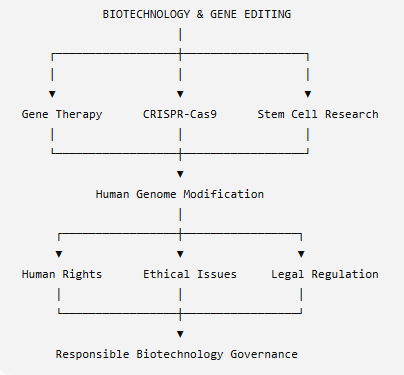
Figure: Conceptual Background
International human rights law increasingly recognizes that advances in biotechnology must be balanced against the protection of fundamental rights including equality, non-discrimination, privacy, health, and respect for human dignity. Several international legal instruments, including the UNESCO Universal Declaration on the Human Genome and Human Rights, the Convention on Biological Diversity, the Cartagena Protocol on Biosafety, and the Council of Europe's Oviedo Convention, establish important ethical and legal principles governing biotechnology research and application. National governments have similarly adopted regulatory frameworks addressing clinical trials, genetic testing, stem cell research, biosafety, and genome editing while attempting to encourage scientific innovation. Nevertheless, legal regulation often struggles to keep pace with rapidly evolving biotechnology. This paper critically examines the legal perspectives governing biotechnology and gene editing through a comparative analysis of international legal frameworks, human rights principles, bioethical standards, and contemporary regulatory developments. It explores the opportunities and challenges presented by modern biotechnology while proposing legal reforms necessary to ensure responsible scientific innovation that respects human dignity, protects fundamental rights, and promotes equitable access to biotechnology in the twenty-first century.
International and Comparative Legal Framework Governing Biotechnology and Gene Editing#
The rapid advancement of biotechnology and gene-editing technologies has prompted governments and international organizations to establish comprehensive legal frameworks that balance scientific innovation with the protection of human rights, public health, and environmental safety. Although there is no single global treaty exclusively regulating biotechnology and gene editing, several international legal instruments collectively provide the foundation for responsible governance. The Universal Declaration of Human Rights (1948) recognizes the inherent dignity, equality, and rights of every individual, principles that remain central to debates surrounding genetic manipulation and biomedical research. The International Covenant on Civil and Political Rights (ICCPR) and the International Covenant on Economic, Social and Cultural Rights (ICESCR) further recognize the rights to privacy, health, and scientific progress while emphasizing that technological advancement must not compromise fundamental human rights. One of the most influential international instruments is UNESCO's Universal Declaration on the Human Genome and Human Rights (1997), which declares the human genome as the heritage of humanity and emphasizes that genetic research must respect human dignity, informed consent, confidentiality, and non-discrimination. UNESCO's Universal Declaration on Bioethics and Human Rights (2005) further establishes ethical principles including autonomy, justice, beneficence, equality, solidarity, and social responsibility in biomedical research. Within Europe, the Council of Europe's Convention on Human Rights and Biomedicine (Oviedo Convention, 1997) represents the first legally binding international treaty addressing biomedical ethics. It prohibits genetic modification intended to alter the genome of future generations except for preventive, diagnostic, or therapeutic purposes that do not affect descendants. Environmental aspects of biotechnology are governed by the Convention on Biological Diversity (CBD) and the Cartagena Protocol on Biosafety (2000), which regulate the safe handling, transport, and use of living modified organisms while protecting biodiversity and ecosystems. National legal frameworks similarly reflect diverse regulatory approaches. The European Union regulates gene-editing technologies through stringent clinical trial regulations, biotechnology directives, pharmaceutical legislation, and data protection laws including the General Data Protection Regulation (GDPR), which safeguards genetic and health information as sensitive personal data. In the United States, biotechnology oversight is shared among agencies such as the Food and Drug Administration (FDA), the National Institutes of Health (NIH), and the Department of Agriculture (USDA) depending upon the nature of genetic research or biotechnology products. India governs biotechnology through the Environment (Protection) Act, 1986, the Rules for the Manufacture, Use, Import, Export and Storage of Hazardous Microorganisms/Genetically Engineered Organisms, and oversight by bodies such as the Genetic Engineering Appraisal Committee (GEAC) and the Indian Council of Medical Research (ICMR), which issue ethical guidelines for stem cell research and genome editing. Comparative legal analysis demonstrates an emerging international consensus that biotechnology should advance scientific progress while ensuring transparency, accountability, biosafety, informed consent, equitable access, environmental protection, and respect for human dignity. As gene-editing technologies continue to evolve rapidly, greater international cooperation and harmonized regulatory standards will be essential for promoting responsible innovation while preventing misuse and protecting future generations.
Legal Challenges, Opportunities, and Ethical Considerations of Biotechnology and Gene Editing#
Biotechnology and gene-editing technologies present extraordinary opportunities for improving human health, agricultural productivity, environmental sustainability, and scientific knowledge, yet they also create profound legal and ethical challenges that require careful regulation. One of the most significant legal concerns relates to human genome editing, particularly germline modification, which introduces permanent genetic changes capable of being inherited by future generations. While somatic gene editing offers promising therapeutic applications for treating diseases such as sickle cell anemia, cystic fibrosis, muscular dystrophy, and certain cancers, germline interventions raise ethical questions concerning consent, human dignity, genetic diversity, and the possibility of unintended long-term consequences. Another major issue involves genetic privacy and data protection. Advances in genome sequencing have resulted in the collection of extensive genetic information, creating risks of unauthorized disclosure, misuse of personal genetic data, identity theft, and discrimination by employers, insurers, or governmental agencies. Robust legal safeguards are therefore essential to protect confidentiality and ensure that genetic information is processed lawfully and securely. Genetic discrimination has emerged as another important human rights concern. Individuals possessing certain genetic characteristics may experience unequal treatment in employment, insurance, education, or healthcare if appropriate anti-discrimination legislation is absent. Ethical concerns also arise regarding equitable access to biotechnology. High costs associated with advanced gene therapies and precision medicine may widen existing socioeconomic inequalities by limiting access to wealthy populations while excluding disadvantaged communities. Intellectual property rights present additional legal complexities because patents relating to genetic technologies may encourage innovation while simultaneously restricting scientific research and increasing treatment costs. The commercialization of human genes, stem cells, and biotechnology products continues to generate debate regarding ownership of biological materials and fair distribution of scientific benefits. Environmental risks associated with genetically modified organisms (GMOs), synthetic biology, and gene drives further require careful biosafety regulation to prevent ecological harm and unintended consequences for biodiversity. Despite these challenges, biotechnology offers substantial opportunities for advancing human welfare. Gene-editing technologies have demonstrated remarkable potential for eliminating inherited genetic disorders, improving agricultural resilience against climate change, developing disease-resistant crops, accelerating vaccine development, and supporting personalized medicine tailored to individual genetic profiles. Biotechnology also contributes significantly to regenerative medicine, tissue engineering, forensic science, environmental conservation, and sustainable industrial development. Ethical governance therefore requires balancing innovation with the protection of human rights through principles of informed consent, transparency, accountability, non-discrimination, public participation, scientific responsibility, and international cooperation. Regulatory systems should encourage responsible research while ensuring independent ethical oversight, rigorous clinical testing, long-term safety monitoring, and meaningful public engagement in policy development. By integrating legal safeguards with bioethical principles, governments can foster scientific innovation while protecting human dignity, social justice, environmental sustainability, and the rights of present and future generations in the rapidly evolving biotechnology landscape.
Emerging Legal Reforms and Future Directions for Biotechnology Governance#
The continued evolution of biotechnology and gene-editing technologies has created an urgent need for adaptive legal frameworks capable of regulating scientific innovation while safeguarding human rights, public health, and environmental integrity. Future regulatory reforms are increasingly moving toward risk-based governance, under which biotechnology applications are evaluated according to their potential impact on individuals, society, and ecosystems. Gene therapies intended for serious medical conditions may receive expedited regulatory approval subject to rigorous safety assessments, whereas germline editing, reproductive cloning, and genetic enhancement technologies remain subject to stricter ethical scrutiny and legal restrictions. One of the most important future developments involves strengthening international regulatory cooperation. Because biotechnology research frequently involves multinational clinical trials, cross-border genetic data sharing, and global pharmaceutical collaboration, harmonized international standards are essential for ensuring consistent safety requirements and ethical oversight. Organizations such as the World Health Organization (WHO), UNESCO, the Council of Europe, and the Organisation for Economic Co-operation and Development (OECD) continue to advocate coordinated governance mechanisms promoting transparency, accountability, biosafety, and equitable access to biotechnology. Another major area of reform concerns the development of comprehensive legislation addressing genetic privacy and genomic data governance. Future laws are expected to impose stricter obligations regarding informed consent, data minimization, encryption, anonymization, cybersecurity, and limitations on secondary use of genetic information. Regulatory authorities are also likely to introduce mandatory ethical review mechanisms, continuous post-market surveillance, and long-term monitoring of gene-editing therapies to identify unforeseen medical or environmental risks. The incorporation of Explainable Artificial Intelligence (XAI) into biotechnology research represents another emerging trend, enabling scientists, clinicians, and regulators to better understand AI-assisted genomic analysis and personalized medicine decisions. Equal access to biotechnology is expected to become an increasingly important legal objective, encouraging governments to reduce disparities in access to life-saving gene therapies through public funding, international partnerships, and technology transfer initiatives. Environmental governance will similarly expand through stronger biosafety regulations addressing synthetic biology, genetically modified organisms, and ecological risk assessments before environmental release of modified species. Future legal reforms are also likely to strengthen public participation in biotechnology policymaking, recognizing that societal trust depends upon transparency, democratic accountability, and meaningful stakeholder engagement. Universities, research institutions, pharmaceutical companies, and biotechnology industries will be expected to adopt comprehensive ethical governance systems emphasizing scientific integrity, responsible innovation, and compliance with international human rights standards.
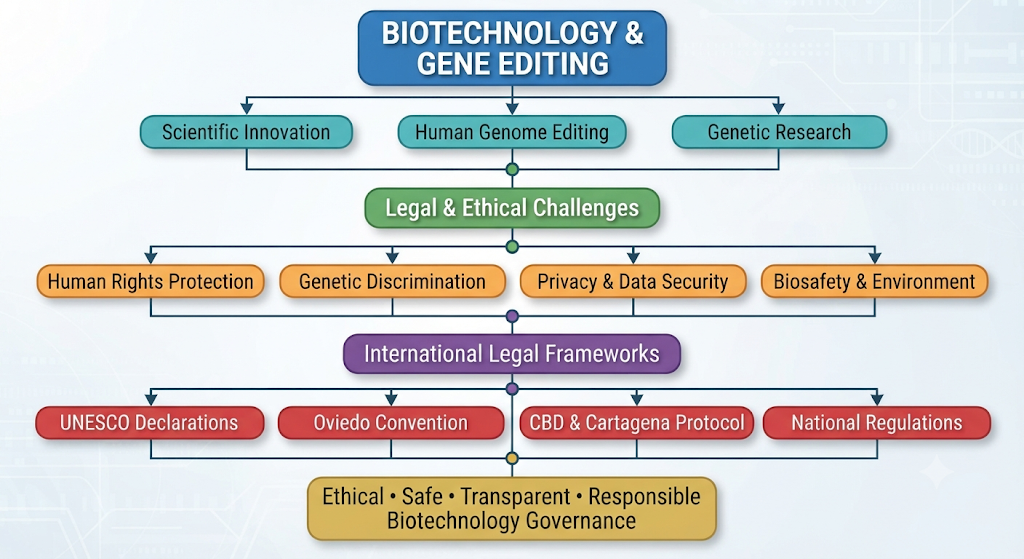
Figure: Legal Governance of Biotechnology, Gene Editing, and Human Rights
Ultimately, the future of biotechnology regulation depends upon creating balanced legal frameworks that encourage scientific discovery while protecting human dignity, equality, environmental sustainability, and the welfare of future generations. Such governance will enable biotechnology to continue addressing global challenges in healthcare, agriculture, and environmental protection without compromising the ethical and legal values that underpin democratic societies.
Conclusion#
Biotechnology and gene-editing technologies have emerged as some of the most transformative scientific developments of the twenty-first century, offering unprecedented opportunities to improve human health, strengthen food security, protect the environment, and accelerate biomedical innovation. Advances in genome sequencing, CRISPR-Cas9 gene editing, stem cell research, synthetic biology, and precision medicine have significantly expanded the ability of scientists and healthcare professionals to diagnose, prevent, and treat diseases that were once considered incurable. These innovations have the potential to improve the quality of life for millions of people while contributing to sustainable development and global public health. However, the rapid pace of technological progress has also generated complex legal, ethical, and human rights challenges that existing regulatory systems often struggle to address effectively. Issues concerning human dignity, informed consent, genetic privacy, discrimination, reproductive rights, biosafety, intellectual property, equitable access to healthcare, and environmental protection require comprehensive legal responses capable of balancing scientific innovation with the protection of fundamental rights. Comparative analysis demonstrates that international organizations such as UNESCO, the World Health Organization, the Council of Europe, and the Convention on Biological Diversity have established important legal and ethical principles governing responsible biotechnology research and application. Similarly, national governments have introduced regulatory frameworks addressing clinical trials, genetic testing, biosafety, and biomedical research while promoting innovation within legally defined boundaries. Nevertheless, significant gaps remain regarding the regulation of germline gene editing, cross-border genetic data governance, commercialization of biotechnology, and emerging applications of artificial intelligence in genomics. Future legal reforms should therefore prioritize transparent governance, robust ethical oversight, privacy protection, international regulatory harmonization, public participation, and equitable access to biotechnology so that scientific progress benefits all members of society without increasing inequality or undermining human rights. Greater collaboration among scientists, policymakers, legal experts, ethicists, healthcare professionals, and international organizations will be essential for developing adaptive legal frameworks capable of responding to rapidly evolving biotechnology. Ultimately, the successful governance of biotechnology depends upon achieving a careful balance between encouraging scientific discovery and preserving the values of human dignity, equality, justice, autonomy, and environmental sustainability. By establishing comprehensive, accountable, and human-centered legal systems, societies can ensure that biotechnology continues to advance human welfare while respecting the fundamental rights and freedoms that form the foundation of democratic governance in the twenty-first century.
Works Cited#
- Convention on Biological Diversity. (1992). Convention on Biological Diversity. United Nations.
- Council of Europe. (1997). Convention for the Protection of Human Rights and Dignity of the Human Being with regard to the Application of Biology and Medicine (Oviedo Convention). Strasbourg: Council of Europe.
- European Parliament and Council of the European Union. (2001). Directive 2001/18/EC on the deliberate release into the environment of genetically modified organisms. Official Journal of the European Union.
- Government of India. (1986). Environment (Protection) Act, 1986. Ministry of Environment, Forest and Climate Change.
- Government of India. (2017). National Ethical Guidelines for Biomedical and Health Research Involving Human Participants. Indian Council of Medical Research.
- Jasanoff, S., Hurlbut, J. B., & Saha, K. (2015). CRISPR Democracy: Gene Editing and the Need for Inclusive Deliberation. Issues in Science and Technology, 32(1), 25–32.
- National Academies of Sciences, Engineering, and Medicine. (2017). Human Genome Editing: Science, Ethics, and Governance. National Academies Press.
- Organisation for Economic Co-operation and Development. (2023). Recommendation on Responsible Innovation in Neurotechnology and Biotechnology. OECD Publishing.
- United Nations. (1948). Universal Declaration of Human Rights. United Nations.
- United Nations. (1966). International Covenant on Civil and Political Rights. United Nations Treaty Series.
- United Nations. (1966). International Covenant on Economic, Social and Cultural Rights. United Nations Treaty Series.
- United Nations Educational, Scientific and Cultural Organization. (1997). Universal Declaration on the Human Genome and Human Rights. UNESCO.
- United Nations Educational, Scientific and Cultural Organization. (2005). Universal Declaration on Bioethics and Human Rights. UNESCO.
- World Health Organization. (2021). Human Genome Editing: Recommendations. World Health Organization.
- World Medical Association. (2022). WMA Declaration of Helsinki – Ethical Principles for Medical Research Involving Human Subjects. World Medical Association.
- Doudna, J. A., & Sternberg, S. H. (2017). A Crack in Creation: Gene Editing and the Unthinkable Power to Control Evolution. Houghton Mifflin Harcourt.
- Nuffield Council on Bioethics. (2018). Genome Editing and Human Reproduction: Social and Ethical Issues. Nuffield Council on Bioethics.
- Greely, H. T. (2021). CRISPR People: The Science and Ethics of Editing Humans. MIT Press.
- Andorno, R. (2004). The Oviedo Convention: A European Legal Framework at the Intersection of Human Rights and Health Law. Journal of International Biotechnology Law, 1(4), 133–143.
- Sandel, M. J. (2007). The Case Against Perfection: Ethics in the Age of Genetic Engineering. Harvard University Press.