Abstract
The rapid expansion of digital governance has transformed the manner in which governments and private organizations collect, process, store, and share personal information. Digital technologies such as cloud computing, artificial intelligence, big data analytics, blockchain, and the Internet of Things have enhanced administrative efficiency, improved public service delivery, and promoted transparency. At the same time, these technological advancements have intensified concerns regarding data privacy, surveillance, unauthorized data processing, cybersecurity, and cross-border data transfers. Consequently, the protection of personal information has emerged as a significant legal and policy challenge across jurisdictions. This paper presents a comparative legal analysis of major data protection regimes, focusing on the European Union's General Data Protection Regulation (GDPR), India's Digital Personal Data Protection Act, 2023, the California Consumer Privacy Act (CCPA), and selected international legal frameworks. It examines the fundamental principles governing personal data protection, including lawfulness, transparency, accountability, purpose limitation, data minimization, and individual rights. The study further explores the challenges posed by emerging technologies, governmental surveillance, algorithmic decision-making, and international data flows within the broader framework of digital governance. By critically comparing legislative approaches and regulatory mechanisms, the paper identifies best practices and existing legal gaps. It concludes that effective data governance requires harmonized legal standards, stronger institutional oversight, technological safeguards, and international cooperation to ensure that innovation and digital transformation are balanced with the protection of individual privacy and fundamental human rights.
- Accountability
- Data Privacy
- Digital Governance
- Personal Information Protection
- Regulatory Compliance
- Right to Privacy
- Surveillance
Introduction#
The digital transformation of governance has fundamentally reshaped the relationship between governments, citizens, and private institutions. Public authorities increasingly rely on digital platforms to deliver welfare benefits, healthcare, education, taxation, identity management, banking, and public administration. Simultaneously, businesses utilize digital technologies to collect, analyze, and monetize personal information for commercial purposes. The rapid integration of artificial intelligence (AI), cloud computing, big data analytics, blockchain, machine learning, facial recognition systems, and the Internet of Things (IoT) has significantly increased the volume and sensitivity of personal data being processed daily. While these innovations have enhanced administrative efficiency, economic development, and citizen participation, they have also generated unprecedented risks relating to unauthorized access, identity theft, cybercrime, algorithmic discrimination, mass surveillance, and misuse of personal information. Data has emerged as a valuable economic resource, often described as the "new oil" of the digital economy, making privacy protection one of the most pressing legal and ethical concerns of the twenty-first century. International recognition of privacy as a fundamental human right under instruments such as the Universal Declaration of Human Rights and the International Covenant on Civil and Political Rights has influenced national governments to enact comprehensive data protection legislation. The European Union pioneered this movement through the General Data Protection Regulation (GDPR), which established globally influential standards emphasizing transparency, accountability, consent, and individual control over personal information. Other jurisdictions, including India through the Digital Personal Data Protection Act, 2023, the United States through sector-specific privacy laws and the California Consumer Privacy Act (CCPA), Brazil through the Lei Geral de Proteção de Dados (LGPD), and several Asia-Pacific nations, have developed their own legal frameworks to address the evolving challenges of digital governance. Despite these legislative developments, considerable differences remain concerning regulatory scope, enforcement mechanisms, cross-border data transfers, data localization, government exemptions, and remedies available to individuals.
Against this background, this paper examines the legal dimensions of data privacy and personal information protection through a comparative analysis of leading legislative frameworks governing digital governance. The primary objective is to evaluate how different jurisdictions balance technological innovation, administrative efficiency, economic development, and the protection of fundamental privacy rights. The study explores the foundational principles of modern data protection law, including lawfulness, fairness, transparency, purpose limitation, data minimization, storage limitation, accountability, and security safeguards. It also critically assesses contemporary challenges arising from artificial intelligence, automated decision-making, predictive analytics, cybersecurity threats, digital identity systems, biometric databases, and international data transfers. Particular attention is devoted to comparing the GDPR, India's Digital Personal Data Protection Act, the California Consumer Privacy Act, and selected international standards to identify similarities, differences, strengths, and regulatory shortcomings. The paper adopts a doctrinal and comparative legal methodology based on statutes, judicial decisions, international conventions, scholarly literature, and policy reports. By identifying best practices and areas requiring legislative reform, the study contributes to the broader discourse on responsible digital governance and sustainable regulatory development. The remaining sections examine the evolution of data privacy law, compare major international legal frameworks, analyze emerging technological challenges, and conclude by proposing recommendations for strengthening personal information protection in an increasingly interconnected digital society.
▼ ▼ ▼#
Government Services Private Organizations Digital Technologies
│ │ │#
└─────────────── Collection & Processing ─────────┘
│
▼
Personal Information
│
▼ ▼ ▼#
Privacy Rights Legal Frameworks Cybersecurity
│ │ │#
└──────── Accountability ──────────────┘
│
▼
Secure & Trustworthy Digital Governance
Figure: Conceptual Background
Evolution of Data Privacy Laws and Digital Governance#
The evolution of data privacy laws is closely connected with the rapid development of information and communication technologies and the increasing digitization of governance systems worldwide. Historically, concerns regarding privacy were primarily associated with physical intrusion into an individual's personal life. However, the emergence of computerized databases during the second half of the twentieth century transformed privacy concerns from physical protection to informational privacy. Governments and organizations gained the ability to collect, store, process, and transmit vast amounts of personal information, creating new risks of surveillance, profiling, and misuse of data. One of the earliest legal responses emerged in Europe during the 1970s, when countries such as Germany and Sweden introduced legislation regulating the automated processing of personal information. These developments were influenced by the recognition that personal data protection constituted an essential component of human dignity and individual autonomy. The concept gained international significance through instruments such as the Organisation for Economic Co-operation and Development (OECD) Privacy Guidelines of 1980 and the Council of Europe's Convention 108 of 1981, which established foundational principles including purpose limitation, data quality, security safeguards, openness, accountability, and individual participation. As the internet expanded during the 1990s and early 2000s, personal data increasingly became a strategic economic asset, prompting governments to adopt more comprehensive regulatory frameworks. The European Union emerged as a global leader in privacy regulation through the Data Protection Directive of 1995 and later the General Data Protection Regulation (GDPR), which came into force in 2018. The GDPR significantly strengthened individual rights by introducing requirements related to informed consent, data portability, the right to erasure, privacy by design, breach notification, and substantial penalties for non-compliance. Its extraterritorial application further influenced data protection policies across the world and established a benchmark for modern privacy legislation. In contrast, the United States adopted a sector-specific approach, regulating personal information through laws addressing particular industries such as healthcare, finance, education, and consumer protection. The California Consumer Privacy Act (CCPA) represented a significant shift toward broader privacy regulation by granting consumers enhanced rights regarding access to, deletion of, and control over their personal information. Meanwhile, emerging economies increasingly recognized the importance of data governance as digital public infrastructure expanded. India, for example, experienced significant growth in digital services through initiatives promoting electronic governance, digital identity systems, online financial transactions, and public service delivery. These developments highlighted the need for a comprehensive legal framework capable of balancing innovation and privacy protection. Following extensive debates and judicial recognition of privacy as a fundamental right in Justice K.S. Puttaswamy v. Union of India (2017), India enacted the Digital Personal Data Protection Act, 2023, establishing a statutory framework governing the processing of digital personal data and emphasizing lawful processing, consent, accountability, and data fiduciary obligations. Similar legislative developments occurred in jurisdictions such as Brazil, South Africa, Japan, Singapore, and Australia, reflecting a global trend toward stronger privacy protection in the digital age. Concurrently, digital governance evolved from simple e-government initiatives to sophisticated systems utilizing artificial intelligence, predictive analytics, biometric identification, and automated decision-making processes. These technologies have improved administrative efficiency and service delivery but have also intensified concerns regarding algorithmic bias, mass surveillance, cross-border data transfers, cybersecurity vulnerabilities, and governmental access to personal information. Consequently, modern privacy law increasingly seeks to reconcile competing objectives of technological innovation, economic growth, national security, administrative efficiency, and fundamental rights protection. The evolution of data privacy law therefore demonstrates a progressive shift from narrow information management regulations toward comprehensive governance frameworks that place individual rights, transparency, accountability, and responsible data stewardship at the center of digital governance policies.
Comparative Analysis of Major Data Protection Frameworks: GDPR, India's Digital Personal Data Protection Act, 2023, and the California Consumer Privacy Act#
The increasing globalization of digital services has prompted jurisdictions worldwide to enact comprehensive legal frameworks for the protection of personal information, although significant differences remain in their regulatory philosophies, scope, and enforcement mechanisms. Among these, the European Union's General Data Protection Regulation (GDPR) is widely regarded as the most comprehensive and influential data protection legislation. Effective since 2018, the GDPR establishes a rights-based framework that emphasizes lawfulness, fairness, transparency, purpose limitation, data minimization, accuracy, storage limitation, integrity, confidentiality, and accountability. It grants individuals extensive rights, including the right to access, rectify, erase, restrict processing, object to processing, and receive their personal data in a portable format. The Regulation also imposes stringent obligations on data controllers and processors, such as maintaining records of processing activities, conducting Data Protection Impact Assessments (DPIAs) for high-risk processing, appointing Data Protection Officers (DPOs) in specified circumstances, reporting personal data breaches within seventy-two hours, and implementing privacy by design and privacy by default. Its extraterritorial application ensures that organizations outside the European Union must comply when processing the personal data of EU residents, thereby establishing the GDPR as a global benchmark for privacy governance. In comparison, India's Digital Personal Data Protection Act, 2023 (DPDP Act) reflects the country's efforts to balance rapid digital transformation with individual privacy rights following the constitutional recognition of privacy as a fundamental right in *Justice K.S. Puttaswamy v. Union of India* (2017). The Act regulates the processing of digital personal data through principles of lawful processing, informed consent, legitimate uses, purpose limitation, data accuracy, security safeguards, and accountability of data fiduciaries. It grants individuals, referred to as Data Principals, rights to access information, seek correction and erasure of personal data, nominate representatives, and obtain grievance redressal through the Data Protection Board of India. Unlike the GDPR, however, the DPDP Act adopts a comparatively flexible approach by allowing broader governmental exemptions for reasons such as national security, public order, and state functions. The Act also provides the Central Government with significant authority to determine cross-border data transfers and designate Significant Data Fiduciaries based on the volume and sensitivity of data processed. The California Consumer Privacy Act (CCPA), as amended by the California Privacy Rights Act (CPRA), adopts a consumer protection model rather than a comprehensive fundamental-rights approach. It provides California residents with rights to know what personal information businesses collect, request deletion, correct inaccurate information, opt out of the sale or sharing of personal data, and limit the use of sensitive personal information. The CCPA primarily applies to qualifying businesses meeting specified revenue or data-processing thresholds and is enforced by the California Privacy Protection Agency. Compared with the GDPR, the CCPA relies more heavily on transparency obligations and consumer choice than on extensive regulatory obligations imposed upon businesses. While all three legal frameworks recognize the importance of individual control over personal information, they differ considerably in their conceptual foundations, enforcement structures, and regulatory intensity. The GDPR adopts the strongest rights-based model with comprehensive safeguards and substantial administrative penalties; the DPDP Act seeks to accommodate India's developmental priorities and expanding digital public infrastructure while introducing accountability measures; and the CCPA focuses on enhancing consumer autonomy within the commercial marketplace. Despite these differences, all three frameworks reflect a common international trend toward strengthening privacy rights, increasing organizational accountability, promoting transparency in data processing, and fostering public trust in digital governance. As emerging technologies such as artificial intelligence, biometric systems, cloud computing, and cross-border digital platforms continue to evolve, further convergence of international privacy standards may become necessary to ensure effective protection of personal information in an increasingly interconnected digital environment.
Challenges to Data Privacy in the Era of Artificial Intelligence, Big Data, and Digital Governance#
The rapid integration of artificial intelligence (AI), big data analytics, cloud computing, the Internet of Things (IoT), blockchain, and digital identity systems has fundamentally transformed digital governance while simultaneously creating complex challenges for the protection of personal information. Governments increasingly rely on digital technologies to deliver public services, manage taxation, healthcare, education, social welfare, law enforcement, and smart city initiatives. Likewise, private organizations continuously collect and process vast quantities of personal data to improve customer experiences, develop predictive models, and support business decision-making. Although these technologies enhance efficiency, transparency, and innovation, they also increase the likelihood of unauthorized access, excessive surveillance, algorithmic discrimination, identity theft, and cyberattacks. Artificial intelligence presents one of the most significant regulatory challenges because machine-learning algorithms depend on large datasets that often contain sensitive personal information. Automated decision-making systems used in recruitment, credit scoring, healthcare, insurance, policing, and public administration may produce discriminatory or biased outcomes when trained on incomplete or prejudiced datasets. The opacity of many AI systems further limits transparency and makes it difficult for individuals to understand how decisions affecting their rights are made. Similarly, big data analytics enables governments and corporations to combine information from multiple sources, creating detailed digital profiles of individuals without their explicit knowledge or meaningful consent. Such profiling may influence consumer behaviour, political participation, employment opportunities, and access to public services, thereby raising concerns regarding autonomy, fairness, and informed consent.
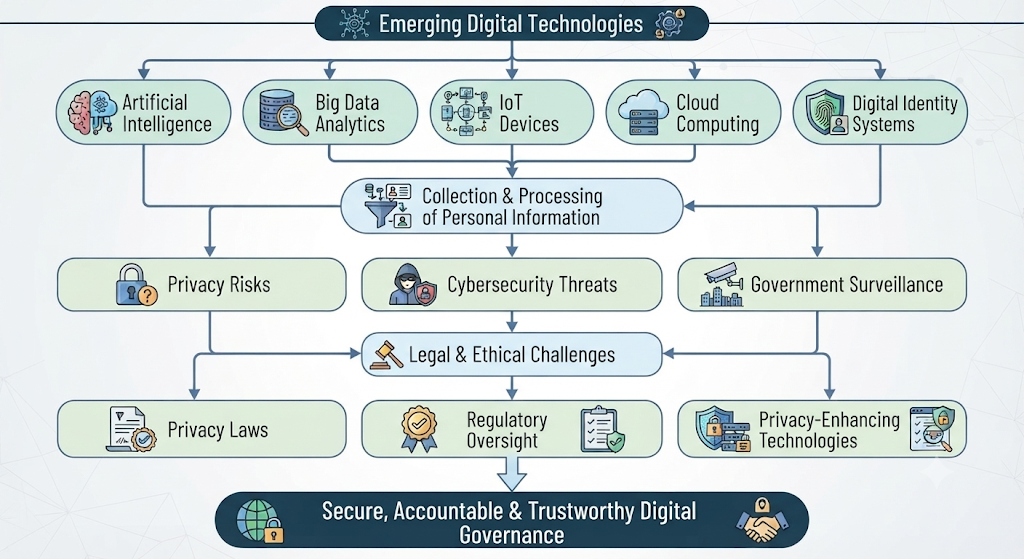
Figure: Challenges to Data Privacy
The widespread adoption of Internet of Things (IoT) devices, including smart home appliances, wearable health monitors, connected vehicles, and surveillance cameras, has significantly expanded the volume of continuously generated personal data. These devices frequently operate with limited security protections, making them attractive targets for cybercriminals seeking unauthorized access to sensitive information. Cross-border data transfers present another major challenge because digital services routinely store and process information across multiple jurisdictions with differing legal standards. The absence of harmonized international regulations often creates uncertainty regarding applicable laws, jurisdictional authority, and enforcement mechanisms. Governments also face the difficult task of balancing national security interests with the protection of individual privacy. While lawful surveillance may be necessary to combat terrorism, cybercrime, and other serious threats, excessive or disproportionate state surveillance can undermine civil liberties, freedom of expression, and democratic accountability. Cybersecurity risks further complicate data governance as ransomware attacks, phishing campaigns, insider threats, and large-scale data breaches continue to expose millions of individuals to financial loss and identity fraud. Consequently, organizations must adopt robust technical and organizational safeguards, including encryption, multi-factor authentication, regular security audits, privacy impact assessments, and incident response mechanisms. Privacy-enhancing technologies such as differential privacy, federated learning, anonymization, pseudonymization, and zero-knowledge proofs are increasingly recognized as valuable tools for reducing privacy risks while enabling responsible data use. Effective governance also requires transparent data management practices, independent regulatory oversight, ethical AI principles, algorithmic accountability, and meaningful public participation in policymaking. International cooperation is equally essential because digital information flows transcend national borders, requiring interoperable legal standards and collaborative enforcement among regulatory authorities. Ultimately, safeguarding personal information in the era of digital governance demands a multidisciplinary approach that combines comprehensive legislation, technological innovation, institutional accountability, cybersecurity resilience, and human rights principles. Such an approach can foster public trust in digital ecosystems while ensuring that technological advancement remains consistent with the fundamental values of privacy, dignity, equality, and democratic governance.
Conclusion#
The rapid advancement of digital governance has fundamentally transformed the collection, processing, storage, and dissemination of personal information by governments and private organizations. While digital technologies have significantly improved administrative efficiency, public service delivery, economic growth, and citizen engagement, they have also introduced unprecedented challenges relating to privacy, cybersecurity, surveillance, and accountability. This comparative legal analysis demonstrates that data privacy is no longer merely a technological or administrative concern but has evolved into a fundamental human rights issue requiring comprehensive legal protection and effective institutional oversight. The comparative examination of the European Union's General Data Protection Regulation (GDPR), India's Digital Personal Data Protection Act, 2023 (DPDP Act), and the California Consumer Privacy Act (CCPA) reveals that although each framework reflects distinct legal traditions and policy priorities, they share common objectives of enhancing transparency, strengthening organizational accountability, empowering individuals with greater control over their personal information, and promoting responsible data governance. The GDPR represents the most comprehensive rights-based approach by establishing stringent obligations for data controllers and processors while providing extensive rights to data subjects. India's DPDP Act reflects an emerging regulatory model that seeks to reconcile privacy protection with developmental objectives, expanding digital public infrastructure, and governmental functions. The CCPA, meanwhile, adopts a consumer-oriented framework that emphasizes transparency and informed consumer choice within commercial data processing. Despite these legislative advancements, significant challenges remain in addressing cross-border data transfers, harmonizing international regulatory standards, regulating artificial intelligence and automated decision-making, preventing algorithmic bias, combating cyber threats, and ensuring meaningful consent in increasingly complex digital environments. Emerging technologies such as artificial intelligence, machine learning, biometric identification, cloud computing, blockchain, and the Internet of Things continue to generate new forms of personal data and create regulatory issues that traditional legal frameworks were not originally designed to address. Consequently, privacy legislation must evolve continuously to remain responsive to technological innovation while safeguarding fundamental rights. Effective data protection requires more than statutory compliance; it demands a holistic governance model integrating legal regulation, ethical principles, technological safeguards, institutional accountability, public awareness, and international cooperation. Governments should strengthen independent regulatory authorities, improve enforcement mechanisms, encourage privacy-by-design practices, and promote transparency in both public and private sector data processing. Organizations should invest in robust cybersecurity measures, conduct regular privacy impact assessments, implement responsible artificial intelligence governance, and adopt privacy-enhancing technologies that minimize risks without restricting innovation. At the international level, greater cooperation is required to develop interoperable privacy standards capable of addressing the borderless nature of digital information flows while respecting national legal systems and cultural diversity. Public awareness and digital literacy should also be enhanced to enable individuals to exercise their privacy rights effectively and make informed decisions regarding the use of their personal information. Ultimately, sustainable digital governance depends upon achieving an appropriate balance between technological progress, economic development, national security, administrative efficiency, and the protection of individual privacy. As societies become increasingly data-driven, policymakers, regulators, businesses, and citizens must collectively contribute to building trustworthy digital ecosystems founded upon transparency, accountability, fairness, and respect for human dignity. Only through such a balanced and rights-oriented approach can digital governance realize its full potential while preserving the privacy, autonomy, and confidence of individuals in the digital age.
Works Cited#
- Bennett, C. J. (2018). The governance of privacy: Policy instruments in global perspective. MIT Press.
- Bygrave, L. A. (2022). Data privacy law: An international perspective (2nd ed.). Oxford University Press.
- Cate, F. H., & Mayer-Schönberger, V. (2019). Notice and consent in a world of big data. International Data Privacy Law, 9(2), 124–138.
- European Union. (2016). Regulation (EU) 2016/679 (General Data Protection Regulation). Official Journal of the European Union.
- Greenleaf, G. (2021). Global data privacy laws 2021: Despite COVID delays, 145 laws show GDPR dominance. Privacy Laws & Business International Report, 169, 3–5.
- Kuner, C. (2020). Transborder data flows and data privacy law. Oxford University Press.
- Lynskey, O. (2015). The foundations of EU data protection law. Oxford University Press.
- Nissenbaum, H. (2010). Privacy in context: Technology, policy, and the integrity of social life. Stanford University Press.
- OECD. (2013). The OECD Privacy Framework. OECD Publishing.
- Puttaswamy v. Union of India, (2017) 10 SCC 1 (India).
- Republic of India. (2023). The Digital Personal Data Protection Act, 2023. Ministry of Law and Justice.
- Richards, N. M., & Hartzog, W. (2019). Privacy's constitutional moment and the limits of data protection. Boston College Law Review, 61(5), 1687–1734.
- Solove, D. J. (2021). Understanding privacy (2nd ed.). Harvard University Press.
- Solove, D. J., & Schwartz, P. M. (2024). Information privacy law (8th ed.). Aspen Publishing.
- Warren, S. D., & Brandeis, L. D. (1890). The right to privacy. Harvard Law Review, 4(5), 193–220.
- Westin, A. F. (1967). Privacy and freedom. Atheneum.
- Zuboff, S. (2019). The age of surveillance capitalism. PublicAffairs.
- California Legislature. (2020). California Privacy Rights Act (CPRA).
- United Nations. (1948). Universal Declaration of Human Rights. United Nations.
- United Nations. (1966). International Covenant on Civil and Political Rights. United Nations.